
Get a Customized Solution for Your IT Needs
+91 702-705-8777
info@pansofic.com
55-56, 1st floor, Chandigarh Complex, Prabhu Prem Puram, Ambala Cantt, Haryana 133006


Search is no longer what it was five years ago—and it's about to change dramatically. Artificial intelligence isn't coming to search; it's already here. The question isn't whether AI will transform how people find information, but how quickly businesses need to adapt.
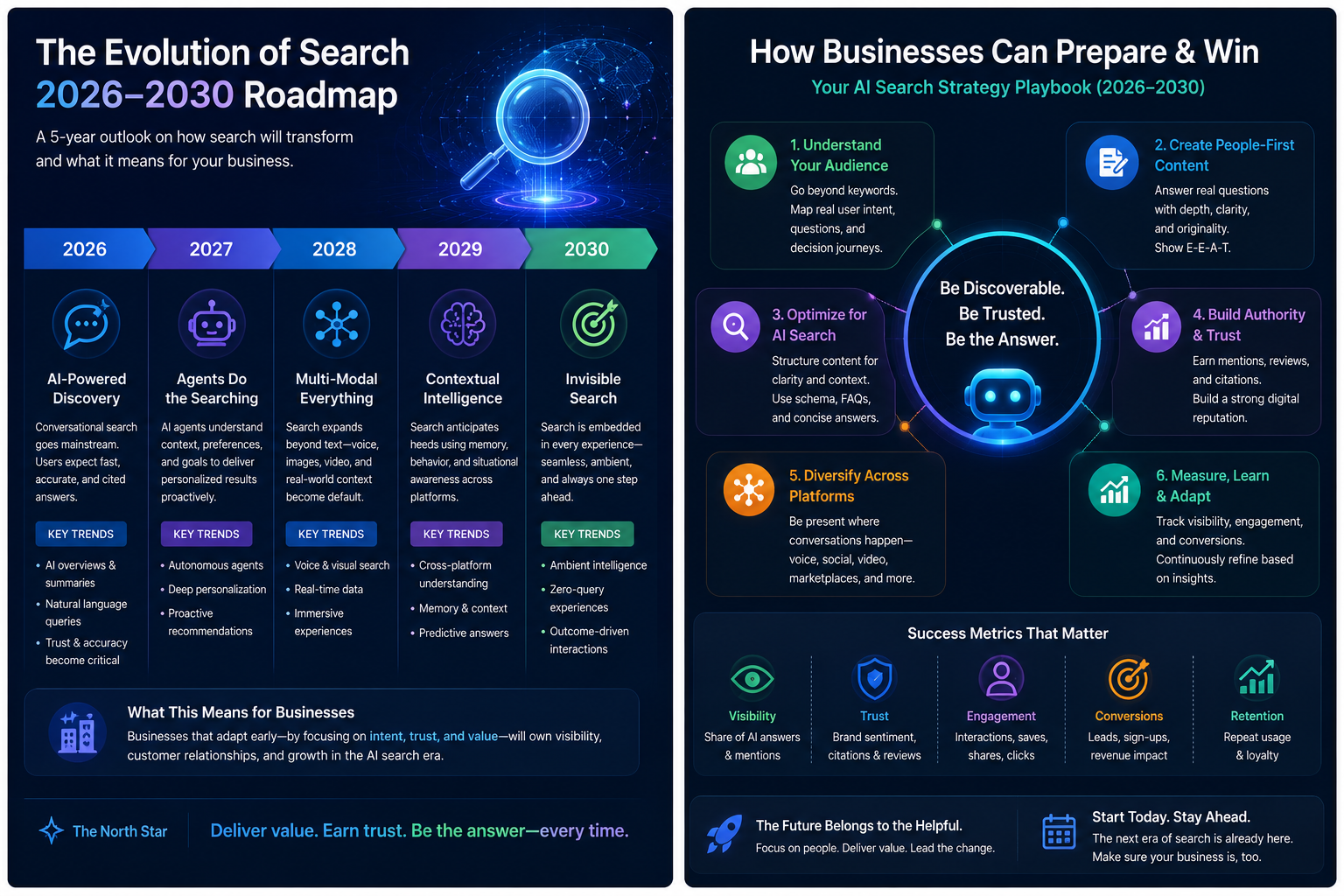
Search is no longer what it was five years ago—and it's about to change dramatically. Artificial intelligence isn't coming to search; it's already here. The question isn't whether AI will transform how people find information, but how quickly businesses need to adapt.
For decades, the search landscape remained relatively stable. You optimized for Google's ranking factors, built backlinks, created content around keywords, and hoped for first-page visibility. This approach worked. Then AI entered the conversation.
Today, we're witnessing a seismic shift. Google introduced AI Overviews. ChatGPT emerged as a search alternative. Specialized AI-powered search engines launched. Voice search and visual search gained prominence. Social media platforms became discovery channels. The traditional 10 blue links are becoming just one of many ways people find answers.
By 2030, the businesses that thrive will be those that adapted early and those that understood search isn't one channel anymore. It's everywhere.
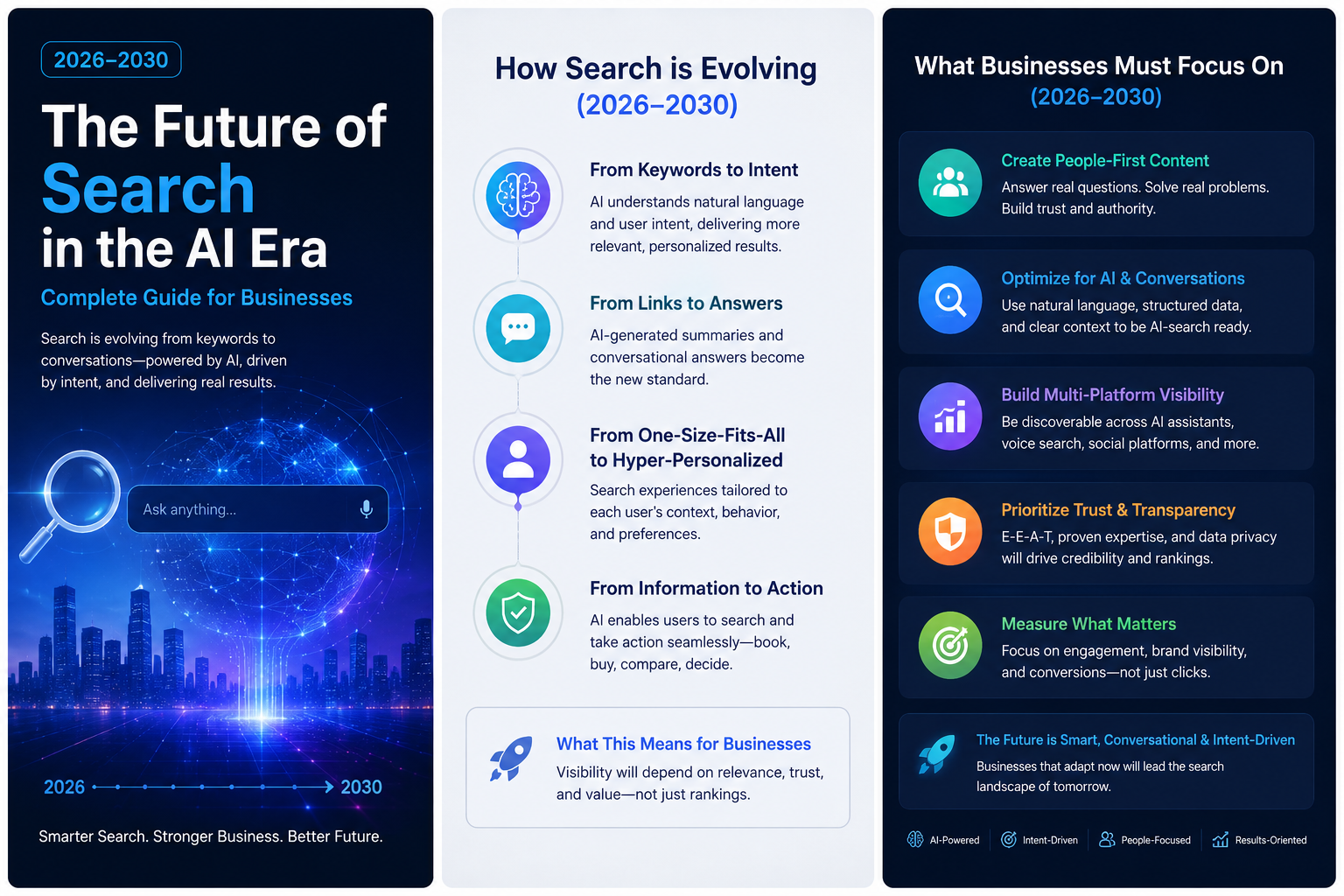
To navigate the future, you need to understand the major forces reshaping search. Think of these as the pillars supporting the new search landscape.
AI Search represents the fundamental evolution of how search engines retrieve and present information. Rather than listing 10 links you might click, AI search engines understand your question, synthesize information from multiple sources, and provide direct answers.
What makes AI Search differently:
Conversational queries work naturally (you ask questions, not type keywords)
Personalization based on conversation history
Chat GPT, Google's AI-powered Gemini, Perplexity, and others represent this shift. They don't just rank content—they consume, analyze, and synthesize it.
Business implication: Being the #1 ranked link doesn't guarantee visibility if an AI search engine synthesizes five sources instead of linking to one.
Google didn't invent AI search, but they're rapidly integrating it into their dominant search platform. Google AI Overviews (previously called Search Generative Experience) displays AI-synthesized answers above traditional search results.
How Google AI Overviews work:
User enters a query
Users can click through for more details or ask follow-up questions
This fundamentally changed how search visibility works. Now you have two potential positions: within the AI Overview or in the traditional rankings.
The paradox: Getting into Google's AI Overview requires ranking well enough to be considered, but appearing in the overview might reduce click-through rates to your site.
Geographic search was always important for local businesses, but AI is reshaping how location information works.
AI's impact on geographic search:
Understanding intent ("best coffee near me" knows you want nearby, not distant)
Contextual location matching (airport vs. residential area searches differ)
Businesses with strong geographic signals—local mentions, geographic keywords, and local backlinks—will maintain an advantage. But traditional local SEO tactics are evolving.
What's changing: Geographic optimization now includes AI-friendly business information, structured data that AI can parse, and presence across multiple platforms and languages.
This is perhaps the most critical shift for businesses. If search is becoming answer-focused rather than link-focused, optimization strategy must change accordingly.
“ Answer engine optimization ” means structuring content to directly answer questions people ask. Not answering through clever SEO, but genuinely answering the question comprehensively and clearly.
AEO focuses on:
Question-answer formats
Cited sources and authority
AEO doesn't replace SEO; it extends it. You still need good SEO fundamentals, but AEO makes your content more likely to be selected as the answer.
Despite all the change, traditional SEO doesn't disappear. Core fundamentals remain important:
Technical SEO (site speed, mobile responsiveness, crawlability)
Backlink quality
What changes is emphasis. Keyword ranking becomes less central; content relevance becomes more so. Link quantity matters less; link quality and relevance matter more.
The lesson: Strong SEO fundamentals are necessary but no longer sufficient.
We're now in the early stages of this transformation. Current trends show where we're heading.
Multiple search destinations: Users no longer default to Google exclusively. They use Google, ChatGPT, specialized AI search engines, social media, and YouTube for information discovery. A unified search experience is fragmenting into multiple specialized searches.
AI Overviews expansion: Google continues integrating AI answers across more query types. More searches now show synthesized answers rather than traditional links.
Specialized search engines: New search engines optimized for different use cases emerge. Shopping searches work differently than research searches; local searches differ from global ones.
Visual and voice prominence: Text-based search remains dominant, but visual and voice searches grow rapidly, requiring different optimization approaches.
Privacy and personalization tension: As AI personalizes search, privacy concerns increase. Regulation around data usage affects how search engines operate.
Looking forward, several trends likely intensify:
By 2030, the concept of "ranking on Google" becomes less meaningful. Instead, businesses optimize for multiple platforms and search types:
Traditional Google rankings
Voice search answers
Success means being visible across multiple channels, not dominating one.
Content optimized for direct answers outperforms content optimized for ranking factors. This doesn't mean longer content; it means clearer, more direct content.
The most visible content directly answers the question asked, cites sources, provides data, and anticipates follow-up questions.
Search becomes increasingly real-time and contextual. News, current events, real-time data, and current prices show in results immediately. Evergreen content remains important, but timely content gains prominence.
AI generates increasingly sophisticated content. Search engines must distinguish AI-generated content from human-created content, perhaps valuing human expertise more highly. Alternatively, they might integrate AI content as standard.
The direction remains uncertain, but content authenticity becomes more valuable regardless.
Search becomes less a "pull" activity (going to a search engine) and more "push" integration (search results appear in the applications and devices you use). Your email gets relevant information. Your calendar shows what you need to know. Your car displays relevant information.
This means search visibility depends less on ranking in search engines and more on being integrated into applications and services people use daily.
Understanding these trends, what should businesses do now to prepare?
Stop thinking "SEO" as optimizing for Google. Instead, think "Search Everywhere."
Develop strategies for:
Traditional search engine rankings
Local search and maps
Each requires different approaches.
As AI becomes more central, machine-readable signals of expertise and authority gain importance. Brands and individuals with verified expertise become more valuable.
Actions to take:
Build author authority (bylines, bios, credentials)
Create content demonstrating deep expertise
Instead of single articles competing for keywords, develop comprehensive topic clusters. Cover all aspects of a topic thoroughly, establishing your site as the authoritative source.
This approach:
Increases likelihood of AI selection
Demonstrates comprehensive expertise
AI engines rely on structured data (schema markup) to understand what your content is about. Proper schema markup makes your content more accessible and useful to AI systems.
Implement structured data for:
Articles and authors
Organization information
Optimize for multiple content formats: text, video, images, interactive tools, podcasts. Different search types favor different formats.
A comprehensive content strategy includes:
Written articles and guides
Data visualizations
The search landscape is evolving rapidly. What works today might not work tomorrow. Build processes for:
Monitoring where your traffic comes from
Adjusting strategy based on data
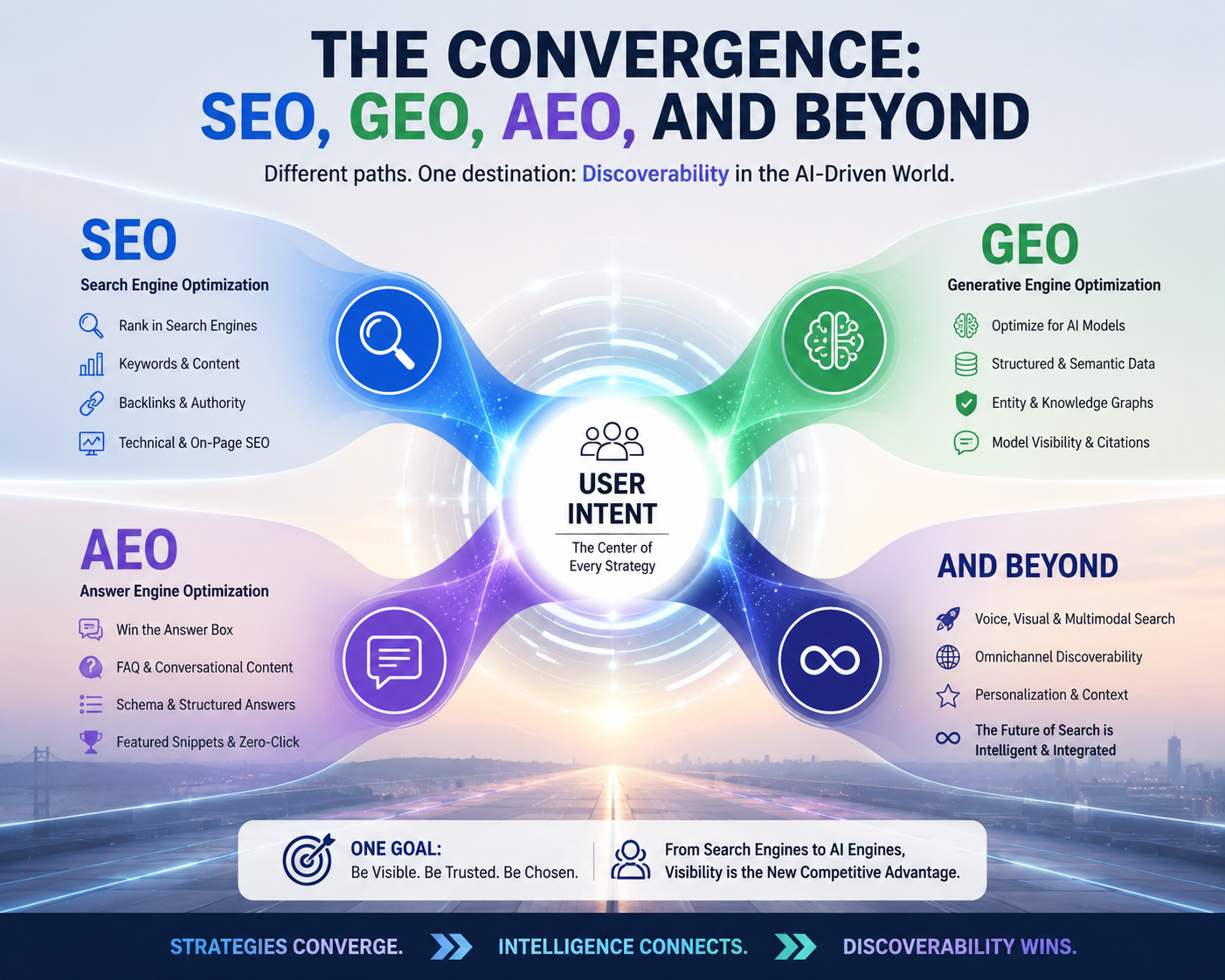
These aren't separate strategies. They converge in the evolved search landscape.
SEO provides the foundational technical and content quality needed for any search visibility.
GEO serves businesses where location matters, integrating geographic signals across platforms.
AEO focuses specifically on being selected as the answer by AI systems.
Together, they create a comprehensive search strategy for the 2026–2030 era and beyond.
This article serves as a foundation connecting key AI search topics. Within your content strategy, develop detailed content on:
AI Search fundamentals and strategy
Mobile-first and app-based search
This pillar-cluster content structure helps both search engines and users understand your comprehensive expertise.
Despite clear trends, the future remains uncertain. AI development might surprise us. Search engines might prioritize differently than expected. New platforms might emerge.
How to prepare for uncertainty:
Build a diverse search presence (don't rely on one channel)
Invest in understanding your audience's search behavior
The future of search isn't something coming in 2028 or 2030. It's already here, and it's evolving monthly. Businesses that wait for clarity will be left behind.
Success in the evolved search landscape requires the following:
Understanding that search has fragmented
Monitoring and adapting continuously
The businesses that thrive in 2030 won't be those that ranked #1 on Google in 2024. They'll be the ones that recognized search was changing, adapted their strategies, and continuously evolved as new search patterns emerged.
Your future search visibility depends on decisions you make today.
Will Google still dominate search in 2030?
Google will likely remain the largest search engine, but dominance will be more fragmented. AI overviews and alternatives will capture a significant share. Success means visibility across multiple platforms, not just Google ranking.
Is traditional SEO dead?
No, traditional SEO fundamentals remain important—site quality, technical excellence, and content relevance. But SEO alone is insufficient. You need a multi-channel search presence.
How do I optimize for AI overviews?
Focus on directly answering questions comprehensively. Use clear structure (headings, lists, and tables); cite sources; and provide data and examples. Being in the top rankings for the query increases the chances of AI Overview inclusion.
Should I stop creating content optimized for keyword ranking?
Not entirely, but shift emphasis. Instead of targeting keywords for ranking, create content that answers the questions people ask. Content optimized for answers often performs well for keyword ranking too.
How should I measure search success if there are multiple search sources?
Track visibility across all relevant channels. Use Google Analytics 4 and similar tools to understand where traffic originates. Set up monitoring for AI search engines and specialized platforms relevant to your business.
What's the biggest mistake businesses make with AI-era search?
Waiting for clarity instead of adapting now. The businesses gaining advantage are experimenting with new platforms, optimizing for multiple search types, and building authority. Those waiting for "best practices" will be behind.


 Seo Admin
Jan 21, 2026
 Seo Admin
Nov 07, 2025
 Seo Admin
Apr 17, 2026
 Seo Admin
Dec 24, 2025
 Seo Admin
Jan 30, 2026