
Get a Customized Solution for Your IT Needs
+91 702-705-8777
info@pansofic.com
55-56, 1st floor, Chandigarh Complex, Prabhu Prem Puram, Ambala Cantt, Haryana 133006






AI search vs Google search explained in plain English. Learn how AI search India is changing discovery and how AI SEO for businesses can keep you visible. Get AI Visibility Audit.
Ask a friend today where they look for answers, and you may hear a surprising mix. Some still type into Google. Others ask ChatGPT, Gemini, or Perplexity. Many do both in the same hour.
That shift matters. If your customers are asking AI tools for recommendations, your business needs to show up there too.
This guide explains AI search vs Google search in plain English. You will learn how each works, how AI search India is growing, and what AI SEO for businesses actually means. You will also get a practical action plan.
If you want to know where you stand right now, you can Get AI Visibility Audit from Pansofic Solutions at any point while reading.
Google Search is a list-based search engine. You type a query, and Google shows a page of results. You then click a link, read the page, and decide what to trust.
Google ranks pages using hundreds of signals. The big ones include:
For Indian businesses, Google is still the main gateway to the internet. Most “near me” searches, product searches, and service searches still start there.
AI search works differently. Instead of giving you ten links, it gives you one written answer.
Tools like ChatGPT, Google Gemini, Perplexity, and Microsoft Copilot read information from many sources. They then summarise it into a direct reply. Google has also added AI-generated summaries, often called AI Overviews, at the top of some results.
The user may never visit a website. They simply read the answer and move on.
That is the big change. In classic search, you compete for a click. In AI search, you compete to be mentioned, cited, or recommended inside the answer.
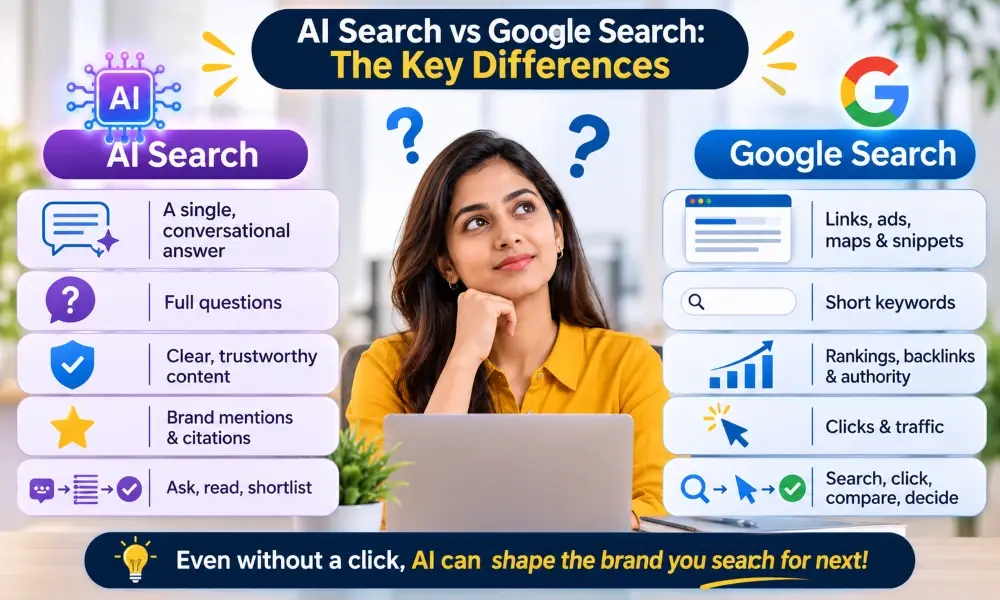
Here is a simple side-by-side view.
Notice the last point. Even when AI does not send a click, it can shape which brand name a customer types into Google next.
India is one of the world’s biggest internet markets. It is also very young, mobile-first, and quick to try new tools.
Several things are pushing AI search India forward:
You do not need exact numbers to see the direction. AI-assisted discovery is becoming a normal habit, not a niche trend.
No. Google is not going away anytime soon.
Google still handles a huge share of searches in India. People still use it to find shops, compare prices, check reviews, and look at maps. Local searches in particular depend heavily on Google.
But the way Google shows results is changing. AI summaries now sit above the usual links on many queries. That means fewer clicks for some topics, especially simple informational questions.
So the real picture looks like this:
You do not need to choose one. You need to be visible in both.
AI SEO for businesses means optimising your website and online presence so AI tools can find, understand, trust, and recommend you.
You may also hear it called generative engine optimisation, or GEO. The goal is the same.
It builds on traditional SEO. It does not replace it. Good SEO still matters, because AI tools often pull information from pages that already rank well and look trustworthy.
The difference is the focus. AI SEO asks:
Wondering how your business scores on those three points? A quick Get AI Visibility Audit review can show you the gaps.
Nobody outside these companies knows the exact formulas. But we can see patterns in what AI answers tend to favour.
AI tools love content that answers a question in the first line. If your page buries the answer under long introductions, it is harder to quote.
AI tools lean on sources that look credible. That includes well-known websites, consistent business details, reviews, and mentions across the web.
Your business name, address, phone number, and services should match everywhere. Mixed-up details confuse both Google and AI tools.
Pages that stay updated, and that match real questions, are more likely to be useful to an AI answer.
Headings, bullet points, short paragraphs, and FAQs make a page easier for machines to read. They also make it easier for humans to read.
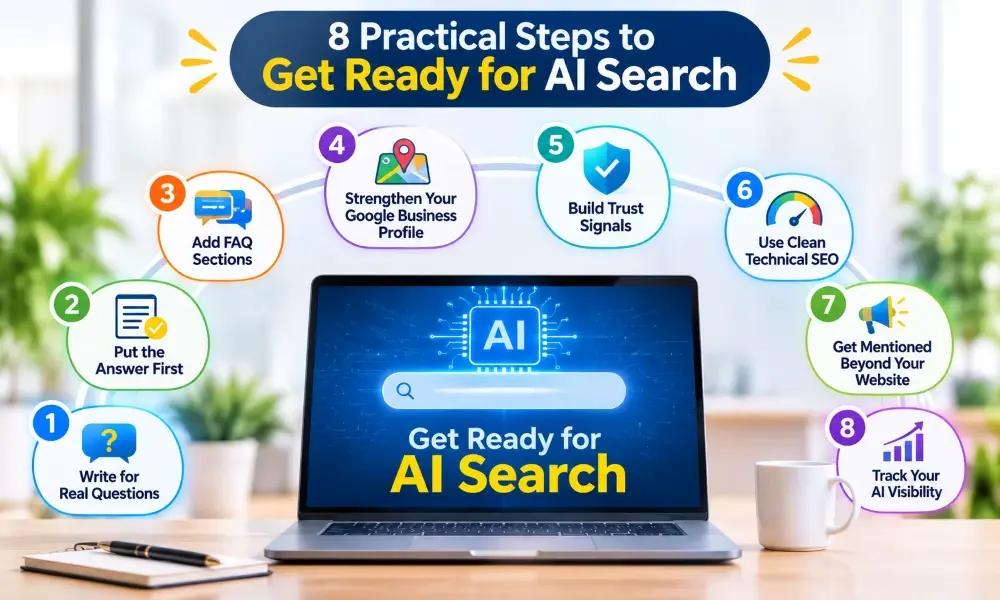
Here is a simple action plan you can start this month.
Think about how a customer would ask an AI tool for help. Then build pages that answer those exact questions.
For example, instead of only targeting “SEO company Ambala,” also answer “How do I choose an SEO company for a small business?”
Start each section with a short, direct answer. Then add detail below it. This is good for readers and easy for AI tools to pick up.
FAQs mirror the way people talk to AI assistants. Keep each answer short, clear, and honest.
Local discovery in India depends on Google Maps and your business profile. Keep your categories, hours, photos, services, and reviews up to date.
Collect genuine reviews. Share case studies. Show your team, your address, and your story. Trust is the heart of both SEO and AI visibility.
Make sure your site loads fast, works well on mobile, and has a clear structure. Add schema markup where it fits, so machines understand your content.
AI tools look at the wider web. Business listings, local directories, industry articles, and quality mentions all help your brand look real and established.
Test your own brand. Ask AI tools questions your customers would ask. See whether you appear, and what the answer says about you.
You can also Get AI Visibility Audit support from Pansofic Solutions to see this clearly, without guessing.
Many Indian businesses are local. Think of clinics, coaching centres, restaurants, salons, builders, and service providers.
For these businesses, AI search is a big opportunity. A customer might ask, “Which is a trusted interior designer in Chandigarh for a 3BHK flat?” The AI tool then gives a short list.
If your business is not clearly described online, you may never make that list.
To stay visible for local AI queries:
Local SEO and AI SEO work as a team. Strong local signals help both.
Avoid these traps as AI search grows.
Feeling overwhelmed? Start small.
Search your brand and key services on Google and AI tools. Note what appears and what is missing. This is also a good moment to Get AI Visibility Audit results so you have a clear baseline.
Update your Google Business Profile. Correct any inconsistent business details.
Rewrite your top service pages with clear answers, short paragraphs, and FAQs.
Ask happy customers for reviews. Publish one helpful guide that answers a real customer question.
Repeat this cycle every month. Small steady steps beat one big rush.
Search is becoming more conversational. Customers will ask longer questions, in their own language, and expect direct answers.
Businesses that explain themselves clearly, earn real trust, and stay consistent online will be easier for both Google and AI tools to recommend.
The winners will not be those who panic. They will be those who prepare early, stay helpful, and keep improving.
The debate of AI search vs Google search is not about picking a side. Google still drives huge value for Indian businesses, and AI search is quickly becoming another important way customers discover brands.
The smart move is to build a strong SEO foundation, make your content clear and trustworthy, and check how AI tools describe your business today.
Ready to see where your brand stands? Get AI Visibility Audit from Pansofic Solutions and find out how visible your business is across Google and AI search, plus what to fix first.
You usually cannot edit an AI answer directly. The better approach is to fix the source. Update your website, Google Business Profile, and listings so the facts are correct and consistent. Strong, accurate information across the web helps AI tools give better answers over time. If a tool offers a feedback option, you can also use it to report errors.
It can, if your customers search that way. Many Indians ask questions in Hindi, Hinglish, or regional languages. Adding clear content in the language your audience uses can help you match those questions. Keep your writing natural and accurate, and make sure your key business details stay the same across every language version.
Reviews can strengthen trust signals about your business, especially on platforms like Google. Detailed, genuine reviews that describe your service and location give useful context. Never buy or fake reviews. They risk penalties and damage real trust. Focus on asking satisfied customers for honest feedback.
There is no fixed timeline. Some improvements, such as fixing business details, can show effects sooner. Building authority, content, and trust usually takes several months. Treat AI SEO as steady, ongoing work rather than a quick fix, and review your progress regularly.
Yes. Many of the most useful steps are low-cost, such as completing your Google Business Profile, writing clear service pages, adding FAQs, and collecting reviews. Start with the basics, then add more advanced work as your budget grows. A focused plan often beats a big, scattered one.
It is a fair concern, and the situation is still developing. For many businesses, being mentioned or recommended still builds awareness and brand searches. Concentrate on making content that is genuinely useful and tied to your brand, so people want to find you directly. Keep an eye on how your traffic and enquiries change, and adjust your plan as needed.


 Seo Admin
Jan 21, 2026
 Seo Admin
Nov 07, 2025
 Seo Admin
Apr 17, 2026
 Seo Admin
Dec 24, 2025
 Seo Admin
Jan 30, 2026