
Get a Customized Solution for Your IT Needs
+91 702-705-8777
info@pansofic.com
55-56, 1st floor, Chandigarh Complex, Prabhu Prem Puram, Ambala Cantt, Haryana 133006






Learn the best website structure for an Ambala local business pages, navigation & local SEO tips to rank higher. Get a free website audit today.
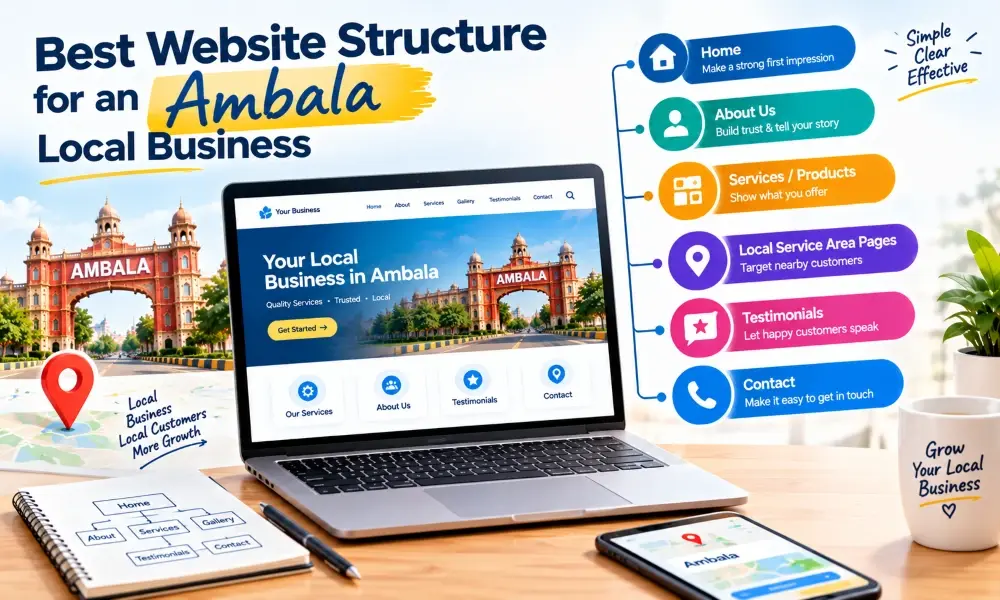
When your customer visits your website, it's his/her first impression of your business, not just before he/she walks into your shop or calls your office. But a good-looking website isn't enough. and neither is picking the wrong team to build it. If you're still deciding who should handle your project, check out our guide on Website Development Company in Ambala: What Should Businesses Look For? before you go further.
The key to attracting customers is the right local business website structure (navigable, quick to load and optimized for local SEO website structure best practices).
In this guide, we'll explain what the structure of an Ambala business website should look like for it to gain more Ambala customers and climb up the Google rankings.
When it comes to local SEO, one of the most crucial elements is the structure of your website.
Many Ambala small business owners are merely concerned with design, colors, images, banners. However, it is structure that determines:
Both users and search engines are confused by a poorly structured website. A well-organized one does just the opposite it leads visitors directly to what they're looking for, and it tells Google what your business is and where you are located.
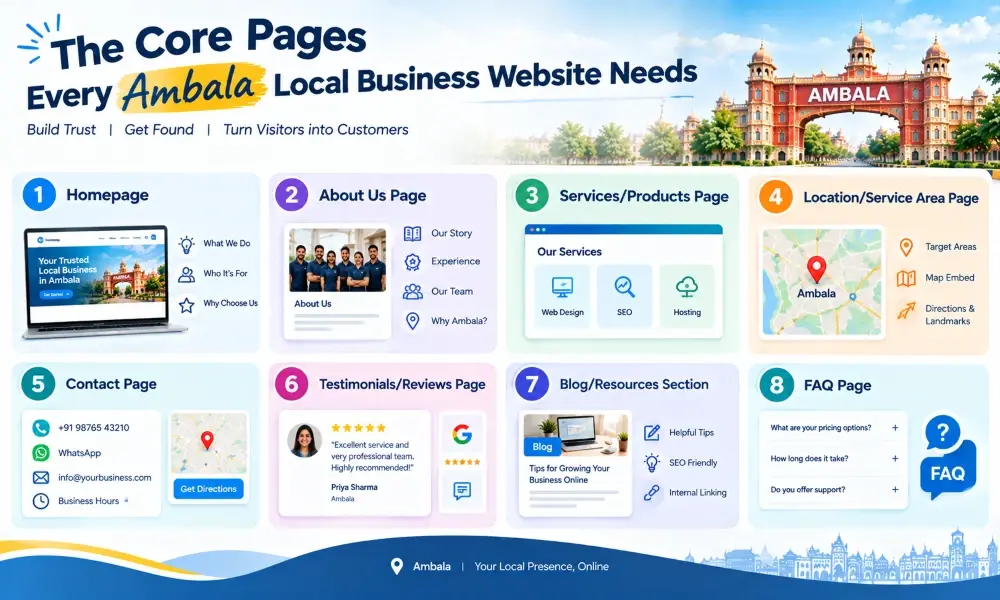
Before putting your mind to design, consider the crucial pages first. This is the backbone of any good local business website structure.
The home page should answer three questions within a few seconds:
Don't clutter the home page. Avoid long paragraphs. Have an enticing title, a concise description, and a prominent call-to-action, such as Get Website Audit" or "Contact Us.
This builds trust. This is a site that local customers are likely to visit before calling a business. Include:
The question here is why did you select Ambala as your root? So, why Ambala?
Don't just provide a bullet list of services on the homepage, but have a page for each major service. For instance, if you have one page with the terms "web design, SEO, hosting," make:
This aids in the local SEO website structure as each page can be optimized for its specific keyword and rank separately.
If you provide service in Ambala and surrounding area, put a page saying:
Just this one page can significantly impact local search visibility.
Be brief and thorough:
People will believe people. If you have a dedicated reviews page, or at least a prominent page on the home page, then you are going to gain credibility in no time at all.
This is the place to answer customer inquiries, optimize for long-tail keywords and establish topical authority. It also helps with internal linking, enhancing your overall site structure.
A separate FAQ page (not part of each individual blog's FAQ) can collect general questions that people look at before selecting any local business, such as price ranges, turn around times or guarantees. This page is a great possibility to be featured in the Google "People Also Ask" section.
The organizational design doesn't have to be identical for all local businesses. See how it changes according to what you provide:
You will have fewer pages and focus your navigation on your customers' search terms by aligning your structure with your business type.
Once your page structure is planned, design becomes the next priority. See our Local Business Website Design in Ambala: Complete Guide to understand how layout, colors, and visuals should work together with this structure.
In the same way, imagine your website as a pyramid, its levels would all address the needs of different visitors, and your home page would add support to the rest of the website.
| Level | Page | Parent Page |
| 1 | Homepage | - |
| 2 | About Us | Homepage |
| 2 | Services | Homepage |
| 3 | Service 1 | Services |
| 3 | Service 2 | Services |
| 3 | Service 3 | Services |
| 2 | Service Area / Locations | Homepage |
| 2 | Blog | Homepage |
| 3 | Blog Post 1 | Blog |
| 3 | Blog Post 2 | Blog |
| 2 | Testimonials | Homepage |
| 2 | FAQ | Homepage |
| 2 | Contact Us | Homepage |
Generally, any page that is more than 3 clicks from the home page is not an important page.
Structure alone isn't enough, it needs to be optimized for local SEO website structure principles. These are the areas to which to pay attention:
Mention "Ambala" in:
Don't keyword stuff: write as a real Ambala shopper would.
Structured data (LocalBusiness schema) is used to share information with Google to help them understand:
This can result in rich snippets appearing in the search results, increasing click-through rates.
Majority of the searches in Ambala are conducted on mobile phone. Your site design should:
Connect your website to your Google Business Profile:
In addition to keywords, Google evaluates context signals indicating that you are a valid local business:
Good navigation is invisible: visitors shouldn't have to think about where to click.
Make sure to not overlook your footer it's a secret SEO opportunity:
The structure of a website goes beyond simply determining what pages are there, it's also about how the content on each page is organised.
Clean URLs are beneficial to both users and search engines. Follow this pattern:
Use short, readable and keyword-rich URLs.
Internal links lead both your customers and Google around your website. Best practices:
This gives your website a lot of topical relevance about each other, which boosts your overall authority of the Ambala business website in Google's eyes.
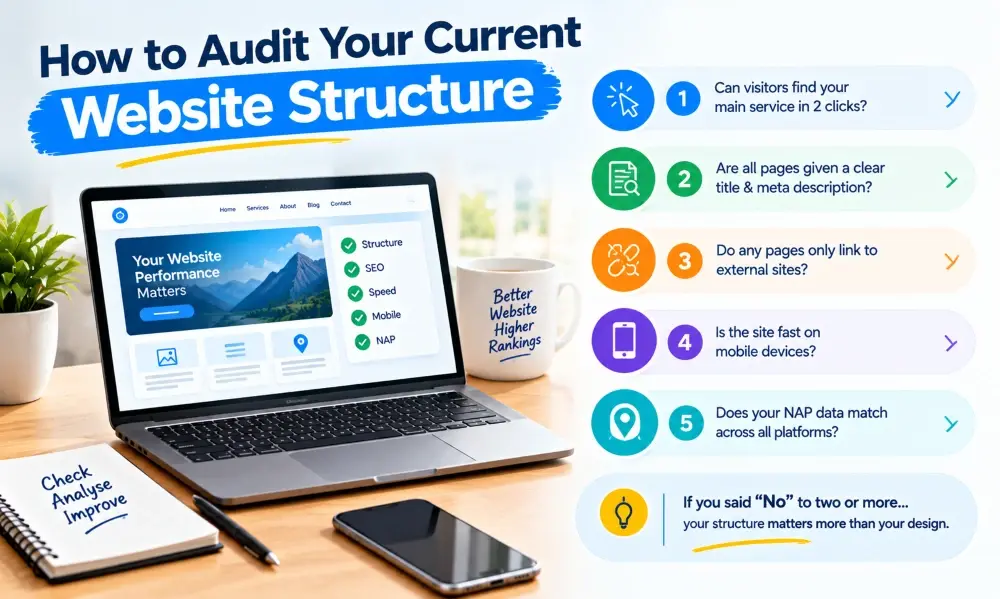
If you already have a site, here is a quick test, you can do to see if any rebuild is necessary:
If you responded with a "no" to two or more of these, your structure probably has more impact on your rankings than your design.
Some additional practices to incorporate into the site design, in addition to those introduced above:
If you can avoid these pitfalls you would be ahead of most of the competitors of Ambala.
The local business website structure isn't so much about design as clarity, speed and search-friendliness. For Ambala company sites, it implies having a tidy method, location-based pages, and also good local SEO web structure methods such as schema markup and consistent NAP information.
If you don't know if your website architecture is supporting or hurting your local search rankings, a local website audit may be worthwhile.
See with Website Audit what are the weaknesses of your website structure and begin attracting more local searches to genuine customers.
Ready to build a website structure that actually brings in local customers? At Pansofic Solutions, we help Ambala businesses design and structure websites that rank and convert.
Most small local businesses will be just fine with 5-8 core pages (Home, About, Services (as 2-3 services, then individual pages), Service Area, Contact, and a Blog section). As your business expands, you can add more to your space.
However, domain age plays a minor role and it does not rank highly. What's more important is the frequency of site updates, the relevance of the content to local searches, and the organization of the site. Well-structured websites can outrank poorly managed sites, even if the latter are older.
Generally, a subfolder (yourdomain.com/blog) is preferable for local businesses rather than a subdomain (blog.yourdomain.com). Subfolders retain the SEO authority in your primary domain, improving your website's rank.
Periodic review is 6-12-monthly, but it's not something that needs to be changed out often. As your site expands, keep adding new pages of service, keeping them relevant, and as you grow, prune out old content to ensure that your navigation now makes sense.
Yes, indirectly. Your Google Business Profile will be used to verify the information and quality of your website. A confusing or outdated website can decrease trust factors that can affect the rankings in your local pack.
Use no more than 5-7 items. Overstuffed menus leaving visitors with too many choices to make and making your key pages less important. If you have a lot of services, put them in one Services menu item instead of having them in the main menu.


 Seo Admin
Jan 21, 2026
 Seo Admin
Nov 07, 2025
 Seo Admin
Apr 17, 2026
 Seo Admin
Dec 24, 2025
 Seo Admin
Jan 30, 2026