
Get a Customized Solution for Your IT Needs
+91 702-705-8777
info@pansofic.com
55-56, 1st floor, Chandigarh Complex, Prabhu Prem Puram, Ambala Cantt, Haryana 133006






Learn how web design and web development work together in 2026 to improve user experience, SEO, conversions, and business growth with a high-performing website.
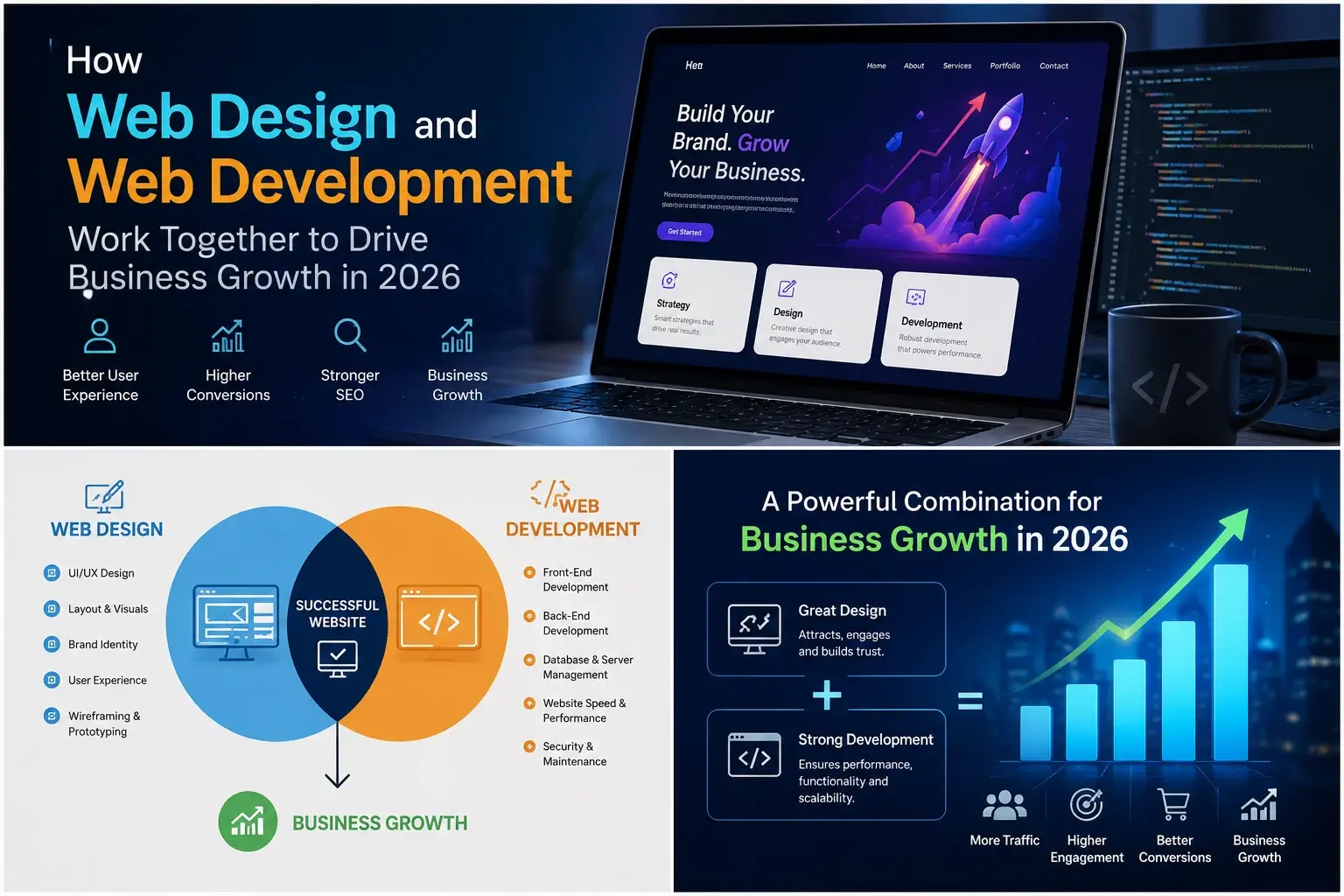
In today's digital landscape, businesses often treat web design and web development as separate entities. However, the most successful websites are built when these two disciplines work in perfect harmony. If you're planning to build or revamp your website in 2026, understanding how design and development complement each other is crucial to your success.
At Pansofic Solutions, we've worked with hundreds of businesses across India—from startups in Ambala to established enterprises—and we've seen firsthand that the synergy between great design and solid development is what truly transforms a website from a digital brochure into a powerful business asset.
This guide reveals the critical intersection between web design and development, how they impact your bottom line, and what you should expect when partnering with a modern web development company.
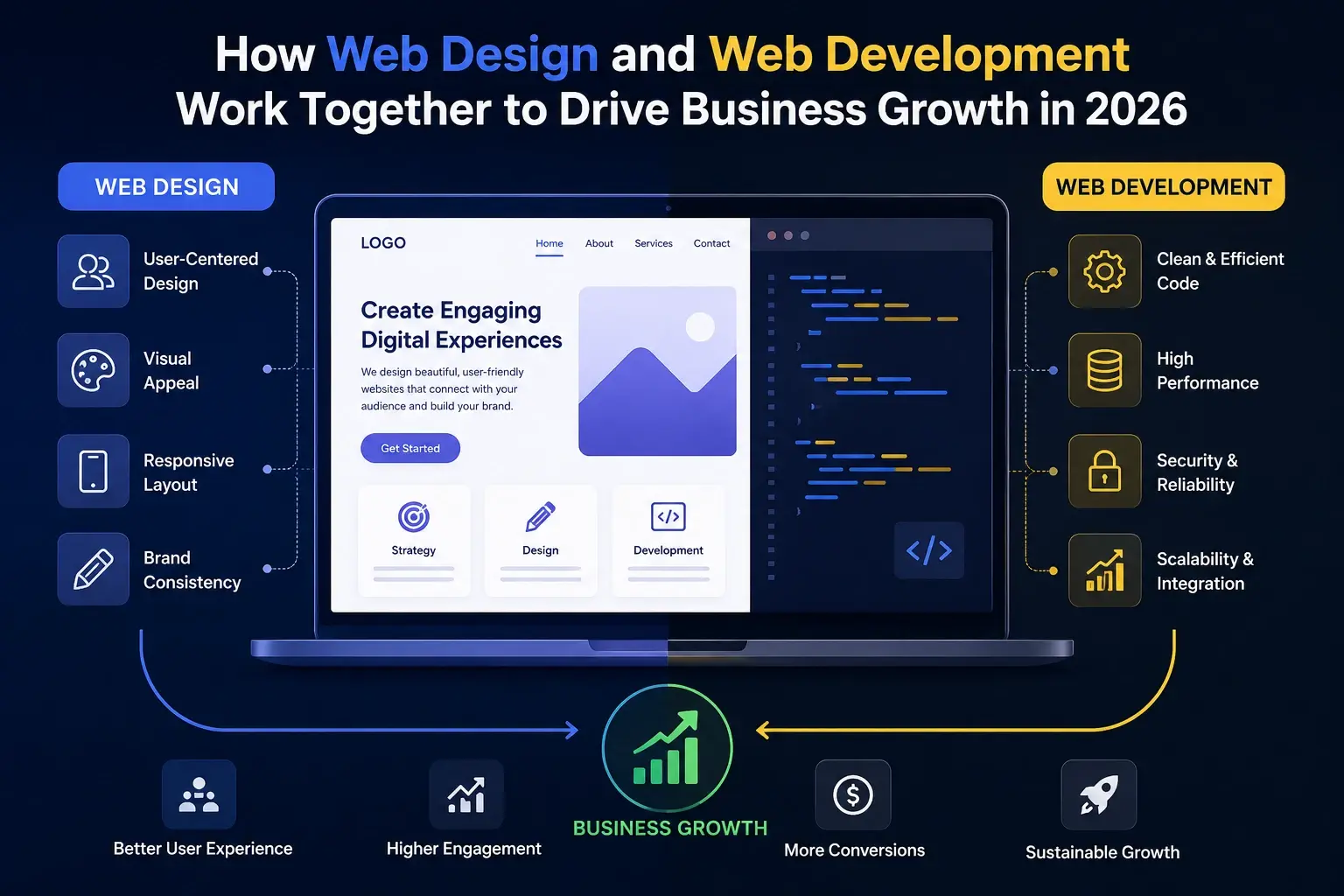
Before we explore their relationship, let's clarify what each discipline brings to the table.
Web design is about creating the visual and interactive experience of your website. It encompasses:
Visual Design - Color schemes, typography, imagery, and overall aesthetics
Responsive Layout - Ensuring the site looks perfect on all devices (desktop, tablet, mobile)
A great web designer thinks like both an artist and a psychologist, understanding how colors influence behavior, how white space improves readability, and how intuitive navigation reduces bounce rates.
Web development is about bringing the design to life and building the technical foundation. It includes:
Front-End Development - Writing code (HTML, CSS, JavaScript) that makes the design interactive in browsers
Maintenance & Scalability - Building systems that can grow with your business
A skilled web developer ensures that the beautiful design actually works flawlessly across all browsers, devices, and situations.
Here's the truth: A beautifully designed website that doesn't load fast is a failure. A technically perfect website that looks outdated is also a failure. The magic happens when both disciplines inform and enhance each other.
The best designers understand technical limitations. They don't design elements that would be impossible to code within budget or timeline. They understand:
How different animations impact site performance
Browser compatibility issues before development begins
This saves thousands of rupees by preventing redesigns mid-project.
Similarly, skilled developers don't just follow designs blindly. They:
Suggest technical solutions that make designs work better
Build systems that allow designs to scale across hundreds of pages
The true focus should always be on user experience. Questions like "Can the user easily find what they need?" require both design and development expertise:
Design asks: "Is the layout intuitive? Are buttons easy to find?"
Development asks: "Does the navigation load instantly? Does the form submit smoothly?"
Together, they create experiences that convert visitors into customers.
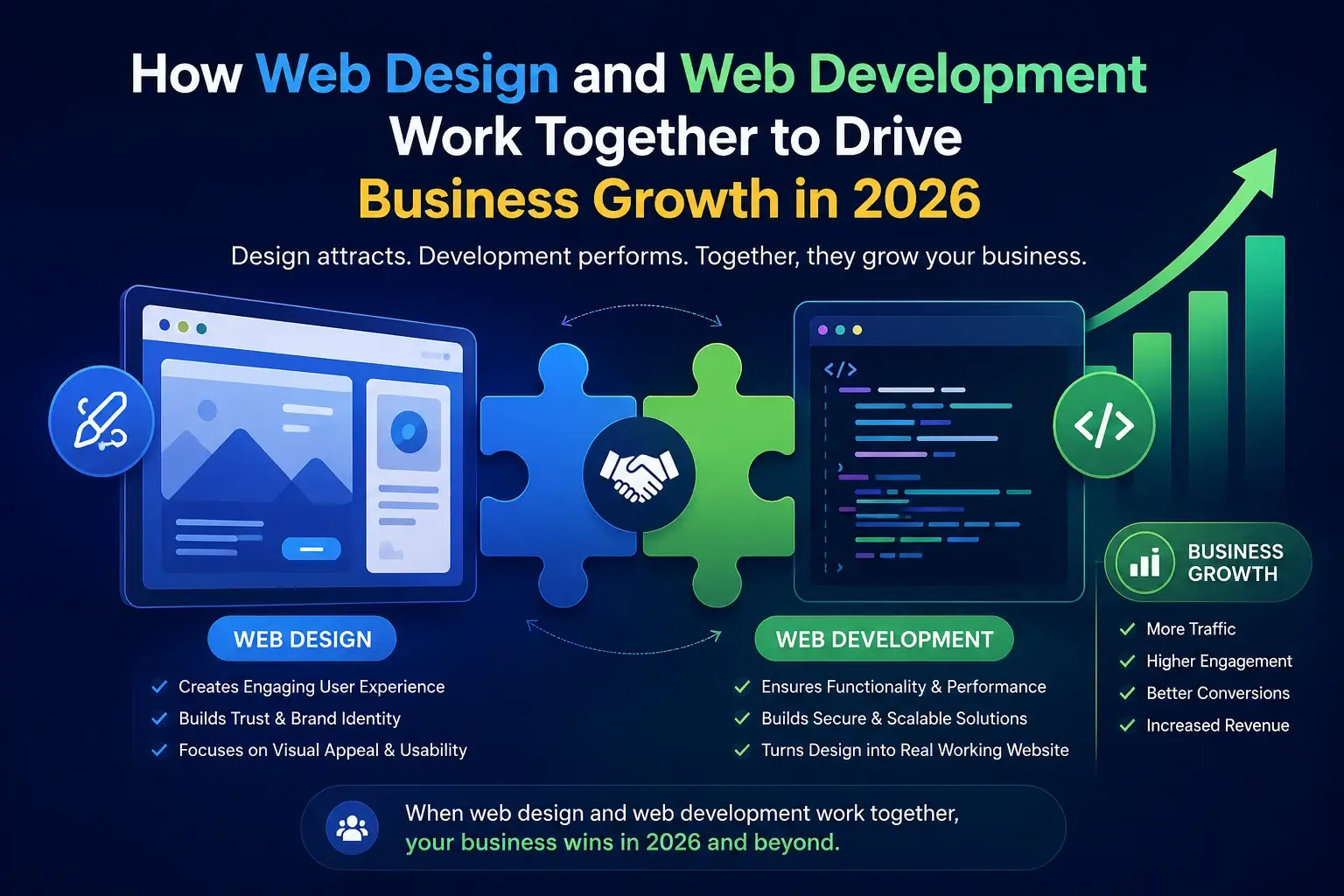
Let's talk about what actually matters: business results. How does the quality of design and development affect your bottom line?
A poorly designed checkout process might have a 1.5% conversion rate. A well-designed and optimized checkout, combined with smooth development, can reach 3-4% or higher. For an e-commerce site doing ₹50 lakhs annually, this difference means ₹25-50 lakhs in additional revenue.
According to industry data, 38-50% of visitors leave a website if it doesn't look visually appealing. Poor design + slow load times (development issue) = high bounce rates. Good design + fast performance = engaged visitors.
Search engines reward websites that:
Load quickly (Development responsibility)
Are mobile-responsive (Both disciplines)
A website optimized by both design and development teams can rank significantly higher, driving more organic traffic and reducing customer acquisition costs.
91% of consumers say they're unlikely to visit a business with an outdated or unprofessional website. Great design + reliable development = credibility and trust.
To illustrate this synergy, let's look at a project we worked on recently (with client details anonymized).
The Challenge: A growing e-commerce business in Punjab with a website that looked decent but converted poorly and had significant performance issues.
The Design Intervention:
Simplified the homepage navigation (less is more)
Optimized for mobile-first experience
The Development Intervention:
Reduced page load time from 4.2 seconds to 1.8 seconds
Created smooth, performant animations (not janky code)
The Results:
Bounce rate: 55% → 32%
Annual revenue increase: ₹38 lakhs
This wouldn't have happened with great design alone or great development alone. Both were essential.
This is perhaps the most critical intersection point in 2026. With 60%+ of web traffic coming from mobile devices, your website must work flawlessly on all screen sizes.
Design challenge: Creating beautiful layouts that adapt gracefully
Requirement: Constant collaboration and testing
Users expect pages to load in under 3 seconds. Design decisions (large images, complex animations, fonts) directly impact performance.
Design: Choosing optimized image formats, limiting animations, strategic white space
Development: Minifying code, implementing caching, optimizing server response
Making websites usable for everyone—including people with disabilities—requires both:
Design: Color contrast, readable fonts, clear visual hierarchy
Development: Semantic HTML, ARIA labels, keyboard navigation
Whether it's a contact form or a complex multi-step process:
Design: Making forms look approachable and easy to complete
Development: Validation, security, and smooth user feedback
Features like sliders, carousels, dropdown menus, and animations:
Design: What it should look like and how it should behave
Development: Making it work smoothly without impacting performance
Here's how professional agencies like Pansofic Solutions approach web projects to ensure design and development work together:
Both designers and developers (and strategists) sit together to understand:
Business goals
Performance targets
Designers create wireframes
They collaborate on feasibility and optimization opportunities
Designers create high-fidelity mockups
Design system is established for consistency
Developers build the website while designers review implementation
Both teams optimize together for performance
QA testing across all browsers and devices
Final refinements before launch
Monitor user behavior and analytics
Continuous optimization based on real data
When choosing a web development company, look for evidence that design and development work together:
The company only has designers or only developers (not both)
There's no mention of collaboration between design and development teams
Design and development teams collaborate throughout the project
They can show examples of well-designed AND high-performing websites
Understanding current trends helps you understand the modern intersection of design and development:
Both designers and developers are using AI tools, but they're complementary:
AI for design acceleration (layouts, color suggestions)
AI for code generation and optimization
Developers are using headless CMS for flexibility, while designers focus on creating amazing front-end experiences with this new architecture.
Designers create design systems; developers build reusable components. This creates perfect alignment.
Web performance is no longer just a development concern—it's a design principle. Design decisions (image sizes, animation complexity) directly affect performance budgets.
Both design and development teams need to ensure the site works perfectly in light and dark modes while maintaining accessibility standards.
Subtle, purposeful animations improve UX but require perfect design-development collaboration to not impact performance.
What happens when design and development don't work together? Unfortunately, we've seen it many times:
Over-engineered websites that are technically impressive but confusing to users
Unhappy users who blame the company for a poor experience
These mistakes can cost ₹2-3 lakhs or more in rework and lost revenue.
If you're building a website, here's how to ensure these disciplines work together:
Work with agencies that have both design and development under one roof. This makes collaboration natural.
Insist that designers and developers communicate throughout the project, not just at handoff points.
Design systems (component libraries, design tokens) create a shared language between design and development.
Modern approaches allow designers to define colors, fonts, and spacing systematically, which developers implement consistently.
Don't leave performance optimization for the end. Budget for it throughout the project.
Have designers and developers do QA testing together, not separately.
Modern design tools integrate with development workflows, reducing miscommunication.
If you're planning a new website or redesign in 2026, here's your action plan:
What do you want your website to achieve? (Lead generation, e-commerce, information, community?)
Look for a web development company where design and development work together. (In Ambala, Chandigarh, or anywhere in India—location matters less than approach.)
A good partner will outline:
How designers and developers will collaborate
Post-launch support and optimization
Ask specific questions:
"How do your designers and developers communicate?"
"What's your approach to responsive design?"
The best websites improve over time. Discuss:
Analytics and user behavior tracking
Quarterly performance reviews
In 2026, the distinction between "web design" and "web development" is less important than their integration. The best websites are built by teams where designers think about performance, accessibility, and technical feasibility, and developers think about user experience, visual polish, and intuitive interaction.
When design and development work together, you get the following:
Websites that look amazing AND perform flawlessly
A true competitive advantage in your market
At Pansofic Solutions, we've seen the transformative power of this integration. Whether you're in Ambala, Chandigarh, Shimla, Mohali, Jammu, or anywhere else in India, we bring together exceptional designers and developers who understand that the most powerful websites are built at the intersection of beauty and functionality.
Ready to build a website that truly drives your business forward? Let's talk about how design and development can work together to transform your digital presence.
Phone: +91 7027-058-777
Jammu, Jammu & Kashmir


 Seo Admin
Jan 21, 2026
 Seo Admin
Nov 07, 2025
 Seo Admin
Apr 17, 2026
 Seo Admin
Dec 24, 2025
 Seo Admin
Jan 30, 2026