
Get a Customized Solution for Your IT Needs
+91 702-705-8777
info@pansofic.com
55-56, 1st floor, Chandigarh Complex, Prabhu Prem Puram, Ambala Cantt, Haryana 133006






Master Technical SEO & AI SEO in 2026. Learn how to improve crawlability, authority, user experience, and AI search visibility with proven strategies.
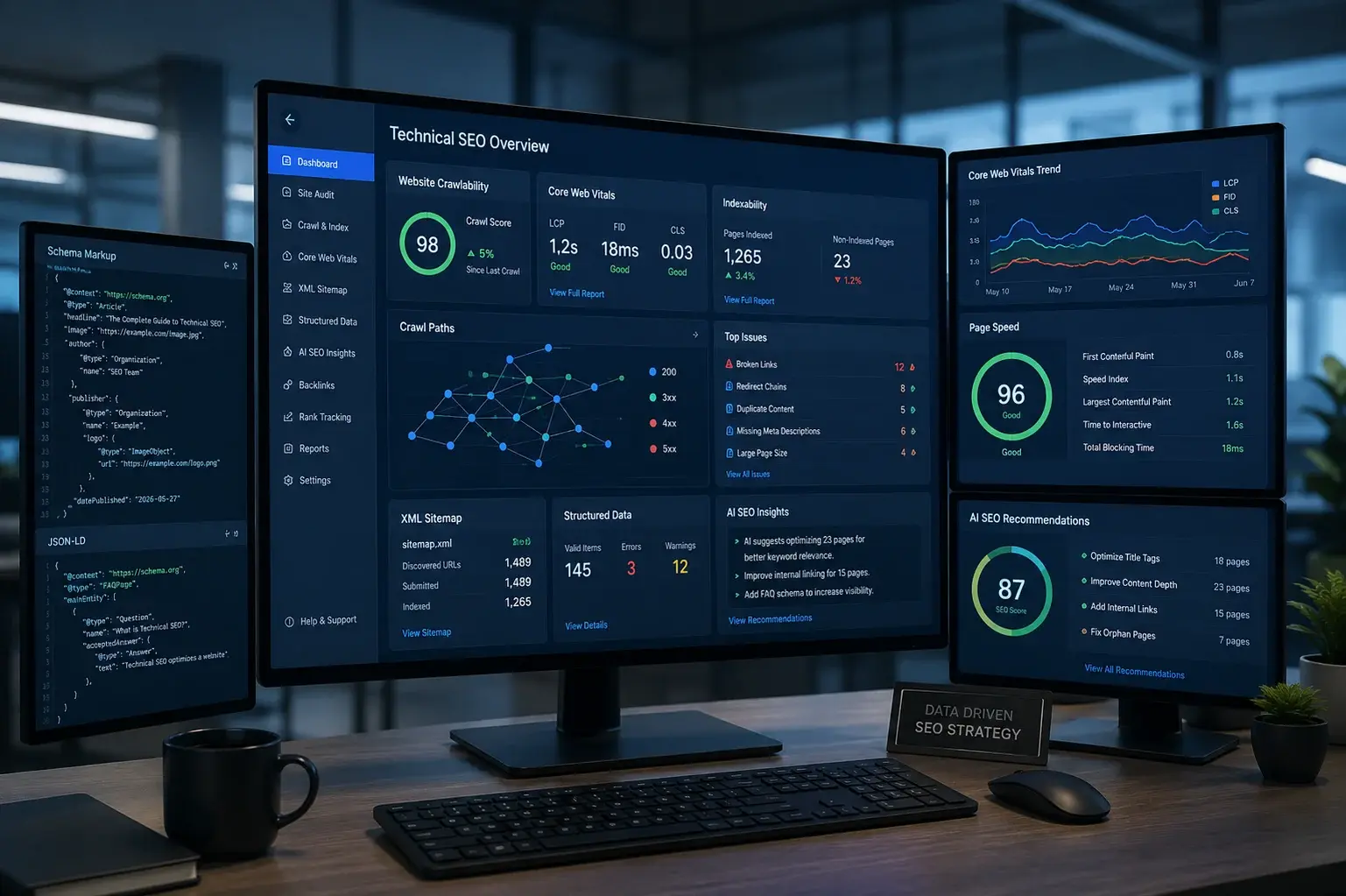
The way we search has changed completely. Simply optimizing for Google's old ranking factors isn't enough anymore. For businesses, effective SEO now requires a deep understanding of technical infrastructure, how AI sees your content, and the new ways people are searching.
Here at Pansofic Solutions, we've dedicated years to mastering technical SEO for our enterprise clients. Whether you're handling an e-commerce site with 10,000 pages or aiming to become a leader in your field, this guide will give you the strategies that set top companies apart.
This guide goes beyond basic SEO tips. It reveals the advanced techniques that enterprise agencies use when they absolutely need to deliver results.
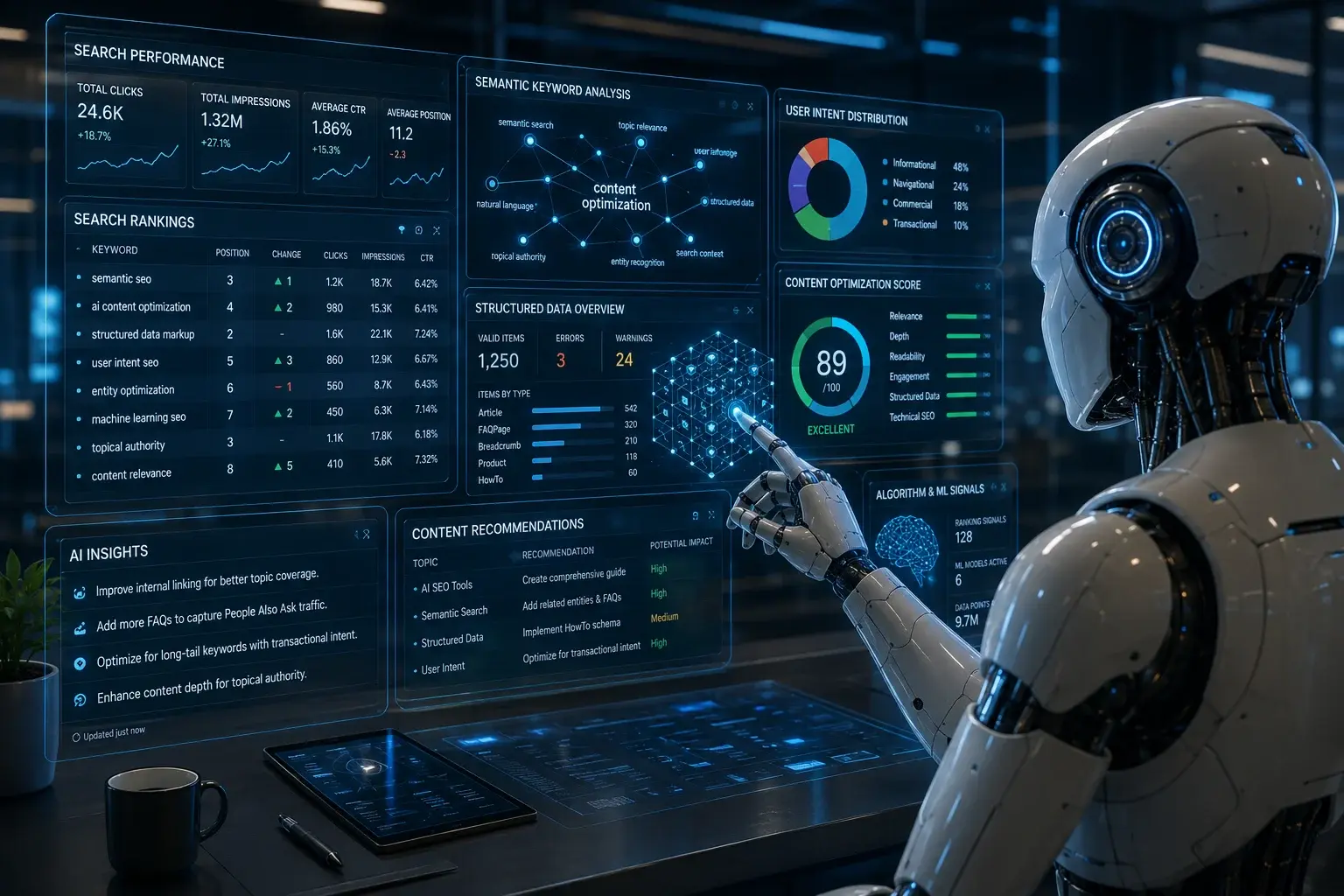
Technical SEO has evolved from basic site speed optimization to a comprehensive framework that includes:
The best part? Unlike content or links, technical SEO is largely within your direct control.
Google's 2023-2025 updates have made one thing crystal clear: technical excellence is non-negotiable. Core Web Vitals directly impact rankings. JavaScript rendering issues prevent indexation. Poor site architecture limits crawl efficiency.
For enterprise sites with thousands of pages, even small technical improvements compound into massive traffic gains.
Your robots.txt file is your first line of communication with search engines—and increasingly, with AI crawlers.
Traditional Search Crawlers:
User-agent: Googlebot
Allow: /
Disallow: /admin/
Disallow: /private/
Crawl-delay: 1
Modern Robots.txt for AI Crawlers:
Today's enterprise sites must account for AI search engines:
Many agencies miss this entirely. Your robots.txt should explicitly allow or disallow AI crawlers based on your strategy.
User-agent: CCBot
Allow: /
User-agent: anthropic-ai
Allow: /
User-agent: PerplexityBot
Allow: /
User-agent: Googlebot
Allow: /
Crawl-delay: 1
If you want your content cited by AI models, ensure your robots.txt welcomes these crawlers. Otherwise, your authority gets captured by competitors who do.
An XML sitemap isn't just a nice-to-have—it's your contract with search engines.
Essential Components:
Best Practices for Enterprise Sites:
<url>
https://example.com/ </loc>
1.0 </priority>
weekly </changefreq>
2026-01-15 </lastmod>
</url>
<sitemapindex>
<sitemap>
https://example.com/sitemap-products.xml </loc>
2026-01-15 </lastmod>
</sitemap>
<sitemap>
https://example.com/sitemap-blog.xml </loc>
2026-01-14 </lastmod>
</sitemap>
</sitemapindex>
Canonical tags tell search engines which version of a page is the "official" one.
Common Canonical Mistakes:
Correct Canonical Implementation:
For e-commerce sites with multiple filter/sort options:
<link rel="canonical" href="https://example.com/products/shoes/" />
For paginated content:
<!-- Page 2 of product listing -→
<link rel="canonical" href="https://example.com/products/shoes/?page=2" />
Self-Referential vs. Strategic Canonicals:
For enterprise sites, strategic canonicals can dramatically boost authority of core pages.
Schema markup is how you tell Google exactly what your content is—not just for rich snippets, but for entity recognition and ranking signals.
Essential Schema Types for Enterprise SEO:
Organization Schema:
{
"@context": "https://schema.org",
“@type” "Organization",
"name": "Pansofic Solutions",
"url": "https://www.pansofic.com",
"logo": "https://www.pansofic.com/logo.png",
"sameAs": [
"https://www.facebook.com/pansoficofficial",
“https://www.linkedin.com/company/pansoficsolutions/”
],
"contactPoint": {
"@type": " Contact Point",
"contactType": "Customer Service",
"telephone": "+91-7027058777",
"email": “info@pansofic.com”
}
}
Local Business Schema (For Multi-Location Enterprises):
{
"@context": "https://schema.org",
"@type": "Local Business",
"name": "Pansofic Solutions Ambala",
"image": "https://example.com/photos/ambala.jpg",
"address": {
"@type": "Postal Address",
"streetAddress": "55-56, 1st floor, Chandigarh Complex",
"addressLocality": "Ambala",
"postalCode": "133006",
“addressCountry” “IN”
},
"telephone": “+91-7027058777”
}
Product Schema (E-commerce):
{
"@type": "Product",
"name": "Enterprise Web Development Service",
"description": “Custom web development for enterprise clients,”
"offers": {
"@type": "Offer",
"price": "50000",
“priceCurrency” "INR",
"availability": “https://schema.org/InStock”
},
"aggregate Rating": {
"@type": "Aggregate Rating",
"rating Value": "4.8",
"review Count": “250”
{
}
5. Crawl Budget Optimization: Making Every Bot Request Count
Google allocates a specific crawl budget to your site. Large sites waste thousands of crawls on low-value pages.
Crawl Budget Strategy:
1. Identify Low-Value Pages: Use Google Search Console → Performance to find pages with:
2. Prioritize High-Value Content:
3. Reduce Crawl Waste:
4. Monitor Crawl Stats:
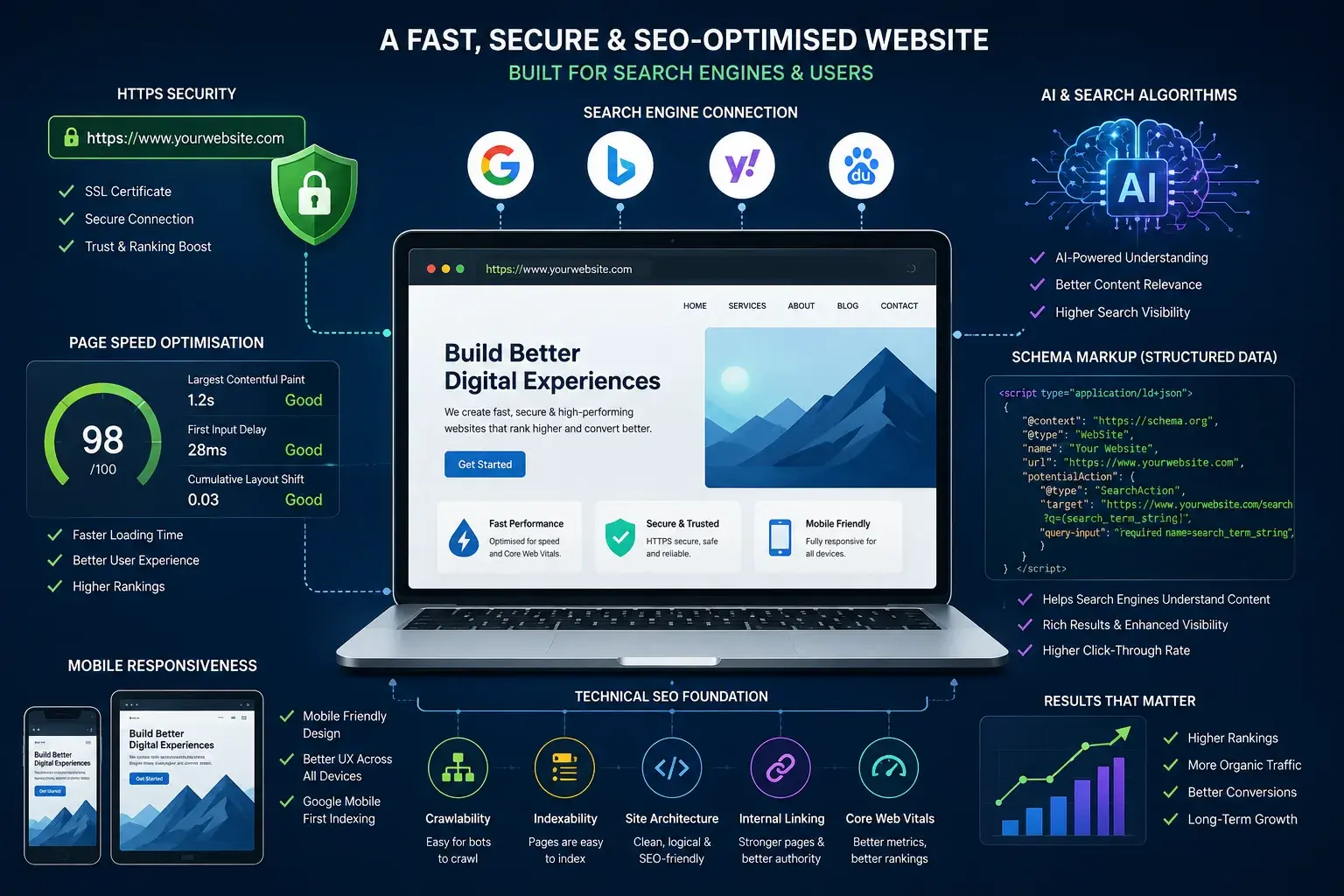
Modern web applications use JavaScript rendering extensively. But not all search engines handle it equally.
The JavaScript Problem:
Solutions for JavaScript-Heavy Sites:
Use Google Search Console → URL Inspection → Test Live URL
Site architecture directly impacts crawlability and rankings.
Enterprise-Level Site Structure:
Domain Root
├── /products/ (Category Hub)
│ ├── /products/software/
│ ├── /products/services/
│ └── /products/solutions/
├── /blog/ (Content Hub)
│ ├── /blog/technical-seo/
│ └── /blog/web-development/
├── /resources/ (Authority Center)
│ ├── /resources/guides/
│ └── /resources/case-studies/
└── /about/ (Trust Center)
Entity-Based Internal Linking:
Instead of random links, link around entities and topics:
Product Page Links to:
→ Related Products (Entity relationships)
→ How-To Guides About This Product (Educational)
→ Case Studies Using This Product (Social Proof)
→ Blog Posts Mentioning This Product (Topical Authority)
This creates thematic clusters that Google recognizes as expertise.
Most agencies ignore server logs. This is a massive mistake.
What Log File Analysis Reveals:
How to Analyze Logs:
3. Key Metrics to Track:
Having 10,000 pages means nothing if only 1,000 are indexed.
Indexation Problems & Solutions:
| Problem | Cause | Solution |
|---|---|---|
| Noindex by mistake | CMS error or staging tag left on | Remove noindex from production |
| Crawl budget exhausted | Low-quality content blocking crawlers | Remove thin/duplicate content |
| Redirect chains | Poor URL migration planning | Direct redirects only (1-hop max) |
| Infinite parameters | Dynamic filters not handled | Use URL parameters intelligently |
Monitoring Indexation:
AI SEO encompasses all strategies to make your content discoverable and citable by AI-powered search engines and language models.
An llms.txt file tells AI models how to responsibly interact with your content.
Basic LLMs.txt Structure:
# LLMs.txt - Directives for Large Language Models
Based on the extension proposed by Anthropic.
[About]
This website's content is intended for informational purposes.
[Allowed Use Cases]
- Search and discovery
- Educational reference
- Content analysis
- Research
[Restricted Use Cases]
- Commercial service training without attribution
- Content republishing
- Building competing products
[Instructions]
Please attribute this source when citing our content.
Link back to the original article when possible.
LLMs.txt Accessibility:
GEO is about making your content the answer that AI models recommend.
GEO Principles:
Q: “What is technical SEO?”
Answer: [Provide a concise, citable definition.]
"According to a 2025 study by [Authoritative Source],
63% of enterprises prioritize technical SEO improvements."
Authoritative Voice: AI models prefer content from recognized experts
AIO is the umbrella term encompassing all AI-focused SEO strategies.
AIO Best Practices:
Google uses entities (people, places, things, concepts) as a semantic web connecting information.
Entity-Based Internal Linking:
Instead of:
"Click here for more information" → Random page
Use entity-based linking:
"IBM's Cloud Solutions" → IBM Company Page → IBM Cloud Product
This creates semantic relationships Google understands.
2. Optimize Your Entity Data:
3. Monitor Your Entity:
High Priority (Fix Within 30 Days):
Medium Priority (Fix Within 60 Days):
Long-Term Priority:
2. Rendering & JavaScript:
3. Schema & Structured Data:
4. Performance:
5. Log Analysis:
While competitors focus on content and links, enterprise leaders dominate through technical excellence.
At Pansofic Solutions, we've built technical SEO frameworks for sites with 100,000+ pages, managing crawl budgets, implementing advanced schema, and optimizing for both traditional and AI search engines.
The organizations winning in 2026 aren't just creating great content—they're ensuring that content is:
Answer: For enterprise sites, XML sitemaps should update automatically whenever your content changes. Most modern CMS platforms (WordPress with Yoast, Drupal, and custom Laravel apps) support dynamic sitemap generation.
Update frequency recommendations:
The key is accuracy over frequency. A stale sitemap is worse than an old one.
Answer: Not separately, but strategically. Your core content optimization (quality, clarity, depth) benefits both traditional search and AI models. However, specific tactics like robots.txt rules for AI crawlers and creating llms.txt are specialized.
If you want your content cited by ChatGPT, Claude, or Perplexity, ensure you:
Restricting AI crawlers is also valid if you prefer traditional search priority.
Answer: Google doesn't publish exact crawl budget numbers, but you can estimate it via:
2. Manual Estimation:
3. Optimization Signs:
If you suspect a low crawl budget, focus on removing low-value content and improving site structure.
Answer: Both consolidate authority but work differently:
| Aspect | Canonical | 301 Redirect |
|---|---|---|
| User Experience | User stays on current page | User sent to target page |
| Authority Transfer | Passes ~90% authority | Passes ~99% authority |
| Use Case | Parameter variations (same content) | Permanent URL changes |
| Example | ?utm_source=facebook on same page | /old-page → /new-page |
Rule: Use redirects for genuine page moves and canonicals for URL variations that serve the same content.
Answer: It depends on the improvement and your site's authority:
Timeline Accelerators:
Patience is critical. Technical SEO compounds—small improvements multiply over time.
Technical SEO isn't something you "set and forget." It's an ongoing discipline that separates enterprise leaders from ordinary competitors.
At Pansofic Solutions, we:
Request a free technical SEO consultation with our enterprise SEO specialists.
Chat with us on WhatsApp: +91 7027058777
We'll identify: ✓ Technical issues limiting your rankings ✓ Crawl budget optimization opportunities ✓ AI SEO readiness assessment ✓ Custom improvement roadmap


 Seo Admin
Jan 21, 2026
 Seo Admin
Nov 07, 2025
 Seo Admin
Apr 17, 2026
 Seo Admin
Dec 24, 2025
 Seo Admin
Jan 30, 2026