
Get a Customized Solution for Your IT Needs
+91 702-705-8777
info@pansofic.com
55-56, 1st floor, Chandigarh Complex, Prabhu Prem Puram, Ambala Cantt, Haryana 133006






Wondering about website development cost in India? Learn what affects business website pricing, features, SEO, design and development costs in 2026
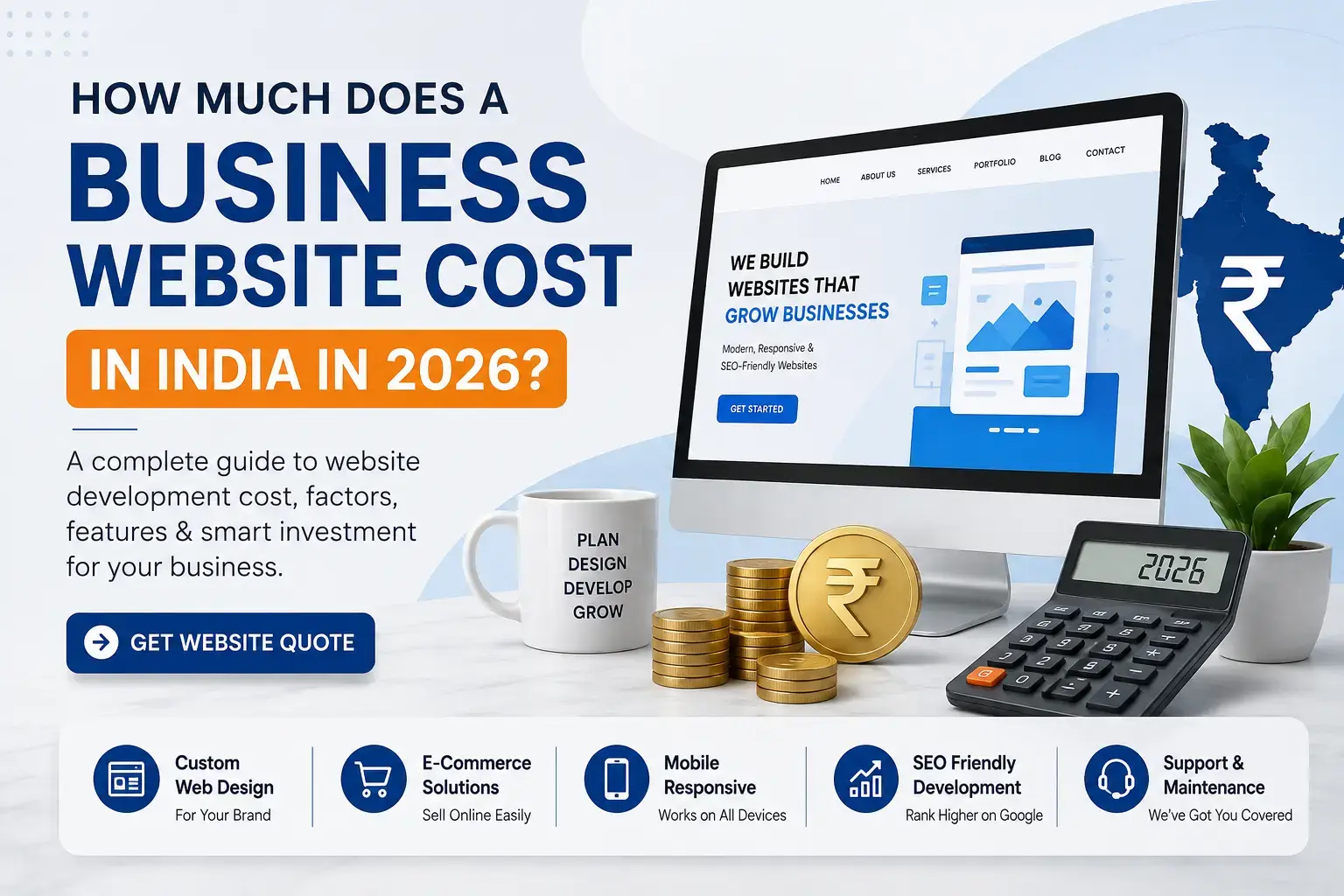
If you're planning to build a website for your business, there's a good chance the first question you're asking is:
“How much will it cost?”
It's a simple question, but the answer isn't always simple.
You may find someone offering a website for a few thousand rupees, while another agency may quote several times more for what sounds like the same thing. So, who is right?
Actually, both can be.
The difference usually comes down to what you're getting for the money.
A five-page website for a local business is very different from an eCommerce store, a custom business platform, or a website built specifically to generate leads from Google.
In this guide, we'll break down the factors that affect website development cost in India in 2026, what you should look for in a quotation, and how to decide what kind of website makes sense for your business.
There isn't one fixed price for every business website.
The cost depends on things like:
For example, a small local service business may only need a clean, professional website with a few important pages.
An online store, on the other hand, may need hundreds of product pages, payment integration, shipping options, inventory management and customer accounts.
Naturally, these two websites won't cost the same.
That's why it's better to decide what your business actually needs before deciding how much you should spend.
Let's look at the most common types of websites businesses usually need.
If you're a freelancer, consultant, local business, startup or service provider, you may not need a complicated website.
A basic business website could include:
The main purpose is simple:
Tell people who you are, what you offer and how they can contact you.
For a small business that is just starting its online presence, this can be a perfectly reasonable place to begin.
But there's one thing you shouldn't compromise on — the website should still look professional and work properly on mobile devices.
This is where things become more interesting.
Suppose you're a dentist, real estate company, coaching institute, travel agency, digital marketing company or any other service business.
You don't just want people to visit your website.
You want them to call you, send an enquiry, book an appointment or request a quotation.
That's where a lead-generation website comes in.
It may include:
The website is no longer just an online visiting card.
It's becoming part of your sales process.
If you're selling products online, the requirements are completely different.
An eCommerce website may need:
And that's just the basic list.
If you have a large product catalogue or need custom features, development can become more complex.
For example, an online store selling 20 products is much easier to manage than one selling 5,000 products with multiple categories, variations and delivery rules.
So when someone asks, “What is the cost of an eCommerce website?”, the correct answer depends heavily on the actual requirements.
Some businesses need something beyond a normal website.
They may need:
At this point, you're moving towards a custom web application rather than a simple business website.
These projects require more planning, development and testing, so naturally the investment is higher.
This is probably the most important part of the discussion.
Imagine two companies ask for a website.
Company A wants a five-page website with basic information.
Company B wants:
Both may say, “We need a business website.”
But the development work is obviously not the same.
Here are some of the biggest factors that influence the final price.

More pages generally mean more planning, design, content and development work.
But don't create pages just to increase the number.
Every page should have a purpose.
For example, instead of putting all your services on one page, individual service pages can make sense when each service targets a different customer need or search query.
A ready-made template can reduce development time.
That's useful when your requirements are simple and your budget is limited.
But templates can also make it harder to create a unique brand experience.
A custom website gives you much more freedom over:
Layout
Branding
User journey
Sections
Functionality
Calls to action
For businesses competing heavily online, that flexibility can be valuable.
This is one of the biggest cost factors.
A website with static information is relatively straightforward.
But if you want:
the development requirements increase.
Here's something many businesses realise too late:
SEO shouldn't be an afterthought.
If you want your website to generate traffic from Google, the structure should support SEO from the beginning.
That can include:
A website can look fantastic and still struggle to perform in search if its technical foundation isn't right.
Pansofic describes its web development services as responsive, SEO-friendly and conversion-focused, with attention to performance and user experience.
Who will write the website content?
This is worth discussing before you accept a quotation.
Some businesses provide all their content themselves.
Others need help with:
If content creation is part of the project, it can affect the overall budget.
Sometimes your website needs to communicate with other software.
For example:
The more integrations you need, the more development and testing may be involved.
Let's be honest.
When you're comparing website quotations, a lower price can look attractive.
But there's another question you should ask:
“What happens after I buy it?”
A cheap website isn't really cheap if:
The better approach is to compare scope, quality and long-term value, not just the number at the bottom of the quotation.
Before choosing a website development company, ask for a clear scope of work.
At minimum, you should understand:
Number of Pages
How many pages are included?
Design
Is the design custom or template-based?
Mobile Responsiveness
Will the website work properly on phones and tablets?
SEO
What technical SEO elements are included?
Content
Who will provide or write the content?
Integrations
Are forms, WhatsApp, payment gateways or other integrations included?
Hosting & Domain
Are hosting and domain charges included or separate?
Maintenance
What support will you receive after the website goes live?
Revisions
How many rounds of changes are included?
Getting these details in writing can save you from unexpected costs later.
This is something businesses sometimes overlook.
Don't start with:
“I have a budget of ₹X. What website can I get?”
Start with:
“What do I want my website to achieve?”
For example:
If your goal is simply online presence
A straightforward business website may be enough.
If your goal is generating leads
You'll need strong service pages, CTAs, forms, trust signals, and conversion-focused design.
If your goal is selling products
You'll probably need eCommerce functionality.
If your goal is building an online platform
A custom web application may make more sense.
The website should fit the business — not the other way around.
Think about your own browsing habits.
How often do you search for a business using your phone?
Your customers are doing the same.
That's why your website should be easy to use on the following:
Buttons should be easy to tap, text should be readable, and important information should not be buried.
Pansofic states that its websites are developed to be responsive across mobile, tablet, and desktop devices.
A business website shouldn't just answer
“Who are we?”
It should also answer:
“Why should I choose you?”
And finally:
“What should I do next?”
That final part is where a clear CTA becomes important.
Depending on the business, your CTA could be
A visitor shouldn't have to search around for five minutes to figure out how to contact you.
At Pansofic Solutions, the approach is not limited to creating attractive web pages.
The company provides web development, web design, digital marketing, mobile app development, software development, and website maintenance services.
Its web development offering focuses on responsive, SEO-friendly, and conversion-oriented websites.
Pansofic's portfolio also includes different types of digital products and business platforms, including TapToExplore, Bizeleven, QuickQRScan, Pansofic Mall, Go Healthy Pro and Destinations Desire.
That variety is important because a restaurant, healthcare business, travel company, eCommerce store, and technology startup don't necessarily need the same kind of website.
The right solution starts with understanding the business and its customers.
Before asking for a quotation, make a simple list.
Step 1: Define your goal
Do you need:
Online presence?
Leads?
Online sales?
Bookings?
Customer accounts?
A complete business platform?
Step 2: List your required pages
Write down the pages you already know you need.
Step 3: List special features
For example:
Payment gateway
Booking
WhatsApp
CRM
API
Customer login
Product catalogue
Step 4: Think about SEO
If Google traffic matters to your business, tell your developer from the beginning.
Step 5: Think beyond launch
Ask how you'll handle:
Updates
Security
Backups
Content changes
Technical support
Future development
Now you're in a much better position to compare quotations.
Final Takeaway
So, how much does a business website cost in India in 2026?
The honest answer is
It depends on what you want the website to do.
A simple business website and a custom eCommerce platform may both be called “websites,” but the amount of planning, design, and development behind them can be completely different.
Instead of searching for the cheapest website, look for a solution that gives you the right combination of the following:
Design + Performance + SEO + Functionality + Security + Scalability + Support
Most importantly, think about the website as an investment in your business rather than just another expense.
A well-planned website can become the place where your customers discover your business, learn about your services, build trust, and finally contact you.
If you're planning a new website or thinking about redesigning an existing one, it's worth discussing your requirements before deciding on a package or budget.
There is no fixed price. The cost depends on the number of pages, design, functionality, technology, integrations, content, and SEO requirements.
Custom functionality and the overall project scope can have a major impact. An informational website is very different from an eCommerce platform or custom web application.
It can be, if the requirements are genuinely simple. However, businesses should check what is included before choosing a low-cost option.
It depends on your requirements, budget, and long-term plans. WordPress can be suitable for many business websites, while custom development may be better when you need specific functionality.
Yes. If organic search is important for your business, SEO-friendly structure, mobile performance, page speed and other technical foundations should be considered from the beginning.
The timeline depends on the project's scope. A simple website can be completed much faster than a custom website with eCommerce, integrations, or advanced functionality.
Yes. Pansofic offers web development and website-related solutions for businesses looking to improve their online presence, performance, and digital experience.
You can contact Pansofic Solutions and discuss your requirements to get a customized proposal rather than relying on a generic price. The Pansofic website provides a Get a Quote option for customized IT requirements.
Don't start with the question, “What is the cheapest website I can get?”
Start with:
“What should my website do for my business?”
Once that is clear, choosing the right technology, features, and budget becomes much easier.
Get a customized website development quote from Pansofic Solutions and discuss what your business actually needs.


 Seo Admin
Jan 21, 2026
 Seo Admin
Nov 07, 2025
 Seo Admin
Apr 17, 2026
 Seo Admin
Dec 24, 2025
 Seo Admin
Jan 30, 2026