
Get a Customized Solution for Your IT Needs
+91 702-705-8777
info@pansofic.com
55-56, 1st floor, Chandigarh Complex, Prabhu Prem Puram, Ambala Cantt, Haryana 133006






Learn what GEO is, how Generative Engine Optimisation works, and how to optimize your website for AI search engines like ChatGPT, Google AI Mode, Gemini, and Perplexity.
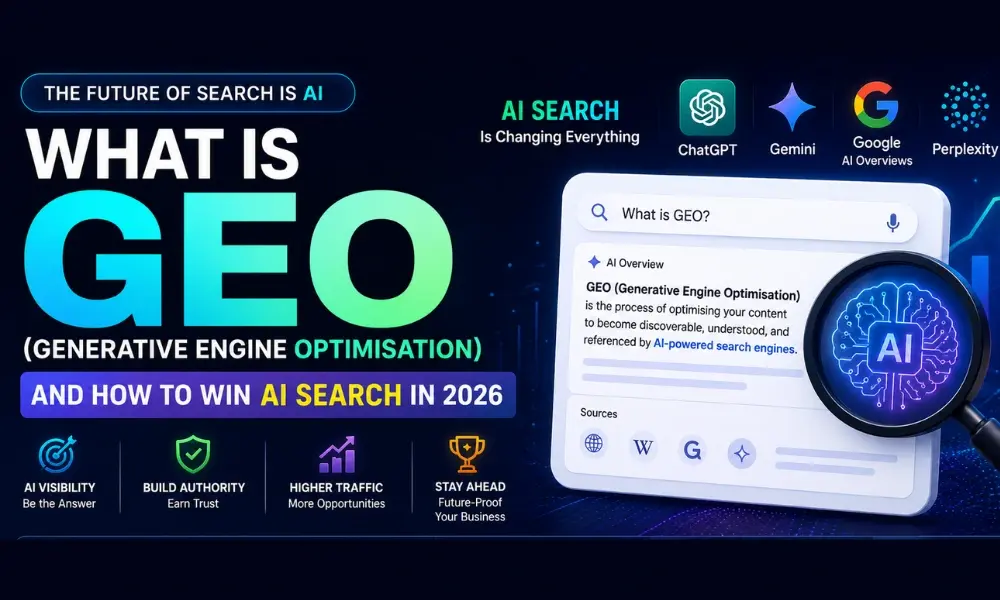
For years, businesses focused on ranking websites on Google using traditional SEO techniques.
The goal was simple:
👉 Rank higher on search engine results pages (SERPs).
However, search is changing rapidly.
Today, users are increasingly getting answers directly from AI-powered search engines such as:
Instead of showing only links, these platforms generate complete answers using information collected from trusted websites.
This shift has introduced a new concept called:
Generative Engine Optimization (GEO).
Just as SEO helps websites rank on search engines, GEO helps businesses become visible inside AI-generated answers.
In 2026, companies that optimize for AI search will gain a significant competitive advantage.
This guide explains what GEO is, how it works, and how businesses can improve their visibility in AI search results.
Generative Engine Optimization (GEO) is the process of optimizing your website and content so that AI search engines can easily understand, trust, and reference your information when generating answers.
Traditional SEO focuses on:
GEO focuses on:
When someone asks:
"Who is the best digital marketing company for small businesses?"
AI systems search multiple sources and generate a summarized answer.
If your website is well-optimized for GEO, your brand has a higher chance of being included in that response.
The way people search online is changing dramatically.
Instead of typing:
"best SEO company in India"
users now ask:
"What SEO company offers the best ROI for small businesses?"
AI engines provide direct answers.
This means users may never click traditional search results.
Businesses that fail to adapt risk losing visibility.
Those that embrace GEO can:
✔ Increase brand authority
✔ Get mentioned in AI responses
✔ Improve trust signals
✔ Generate more qualified traffic
✔ Future-proof their marketing strategy
Many people believe GEO will replace SEO.
That is not true.
Instead, GEO builds upon SEO.
Traditional SEO | GEO |
Focuses on rankings | Focuses on AI mentions |
Targets search engines | Targets AI engines |
Keyword optimization | Entity optimization |
Link building | Authority building |
SERP visibility | AI visibility |
The most successful websites in 2026 combine both strategies.
To understand GEO, you must first understand how AI search works.
AI systems analyze:
The goal is to find the most trustworthy and useful information.
AI engines prefer content that demonstrates:
✔ Expertise
✔ Experience
✔ Authority
✔ Trustworthiness
This is why Google's E-E-A-T framework remains important.
A GEO Audit is the process of evaluating how well your website is prepared for AI-powered search engines.
A GEO audit examines:
Does your content answer real questions clearly?
Can AI understand your brand, services, products, and expertise?
Are you publishing enough content around your niche?
Does your website provide machine-readable information?
Is your business referenced across the web?
Can AI easily quote or summarize your content?
A GEO audit helps identify weaknesses before competitors gain an advantage.
AI engines trust websites that demonstrate deep expertise.
Instead of publishing random articles, focus on content clusters.
For example:
If you offer SEO services, create content around:
This helps AI understand your expertise.
Entities are people, businesses, products, services, and concepts that AI can identify.
AI engines increasingly rely on entity relationships.
Instead of simply targeting keywords, build strong brand entities.
Examples include:
The more consistent your brand information is across the web, the easier AI can understand your business.
AI systems love question-answer content.
Why?
Because users interact with AI conversationally.
Examples:
The more clearly you answer questions, the more likely AI will use your content.
Structured data helps AI understand content context.
Use schema markup for:
This creates machine-readable information.
AI engines trust recognized brands.
Authority can be built through:
The stronger your brand authority, the more likely AI systems will cite your content.
Many SEO strategies still work, but GEO requires additional optimization.
AI prefers complete answers.
Instead of writing 500-word posts, create detailed resources that fully solve problems.
Organize content using:
This improves AI comprehension.
AI engines often reference data-rich content.
FAQs align perfectly with conversational AI search behavior.
Original insights increase credibility.
Although AI engines use different algorithms, common ranking signals include:
Does the content answer the question accurately?
Is the website trustworthy?
Is the information current?
Can AI identify the brand clearly?
Is the content easy to read and understand?
Short, generic articles rarely get cited by AI.
Without schema, AI loses valuable context.
AI understands intent better than exact-match keywords.
Surface-level content struggles to gain trust.
AI favors recognized sources.
Local businesses can also benefit from GEO.
Optimize:
AI engines frequently reference local business data.
Marketing agencies should create content around:
This positions the agency as an authority in the emerging AI search market.
Search behavior is moving toward AI-first experiences.
Future users will increasingly:
Businesses that prepare now will gain a major advantage.
GEO is not replacing SEO.
It is becoming the next layer of SEO.
At Pansofic Solutions , we help businesses prepare for the future of search.
Our services include:
✔ GEO Audits
✔ Technical SEO
✔ AI Search Optimization
✔ Entity SEO
✔ Content Strategy
✔ AI Visibility Optimization
We help brands become discoverable across both traditional search engines and AI-powered search experiences.
Conclusion
Generative Engine Optimization (GEO) is rapidly becoming one of the most important digital marketing strategies.
As AI search engines continue to grow, businesses must go beyond traditional SEO and optimize for AI visibility.
Companies that invest in GEO today will be better positioned to:
The future of search is not just about ranking.
It is about becoming the source AI trusts.
Want to know if your website is ready for AI search?
👉 Get a professional GEO Audit from Pansofic Solutions.
Our experts can help you optimize for:
📞 Contact us today and future-proof your SEO strategy.
Frequently Asked Questions (FAQs)
What is GEO in SEO?
GEO stands for Generative Engine Optimization. It helps websites become visible in AI-generated search results.
Is GEO replacing SEO?
No. GEO complements traditional SEO and focuses on AI search visibility.
What is a GEO Audit?
A GEO audit evaluates how well a website is optimized for AI-powered search engines.
How does AI Search differ from Google Search?
AI search generates direct answers, while traditional search primarily displays links.
Can local businesses benefit from GEO?
Yes. Local businesses can improve AI visibility through reviews, citations, and location-focused content.
What is Generative AI SEO?
Generative AI SEO is the process of optimizing content for AI-powered search systems such as ChatGPT Search and Google AI Mode.
Why is structured data important for GEO?
Structured data helps AI understand content context and relationships.
How can I improve AI search rankings?
Focus on authority, topical expertise, structured data, comprehensive content, and brand recognition.
What industries benefit most from GEO?
Almost every industry can benefit, especially agencies, SaaS companies, ecommerce brands, healthcare providers, and local businesses.
Is GEO important in 2026?
Absolutely. GEO is becoming a critical component of modern search optimization.


 Seo Admin
Jan 21, 2026
 Seo Admin
Nov 07, 2025
 Seo Admin
Apr 17, 2026
 Seo Admin
Dec 24, 2025
 Seo Admin
Jan 30, 2026