
Get a Customized Solution for Your IT Needs
+91 702-705-8777
info@pansofic.com
55-56, 1st floor, Chandigarh Complex, Prabhu Prem Puram, Ambala Cantt, Haryana 133006






Learn what a high-converting service page needs from headline to CTA with SEO best practices, trust signals, and FAQs. Improve yours today.
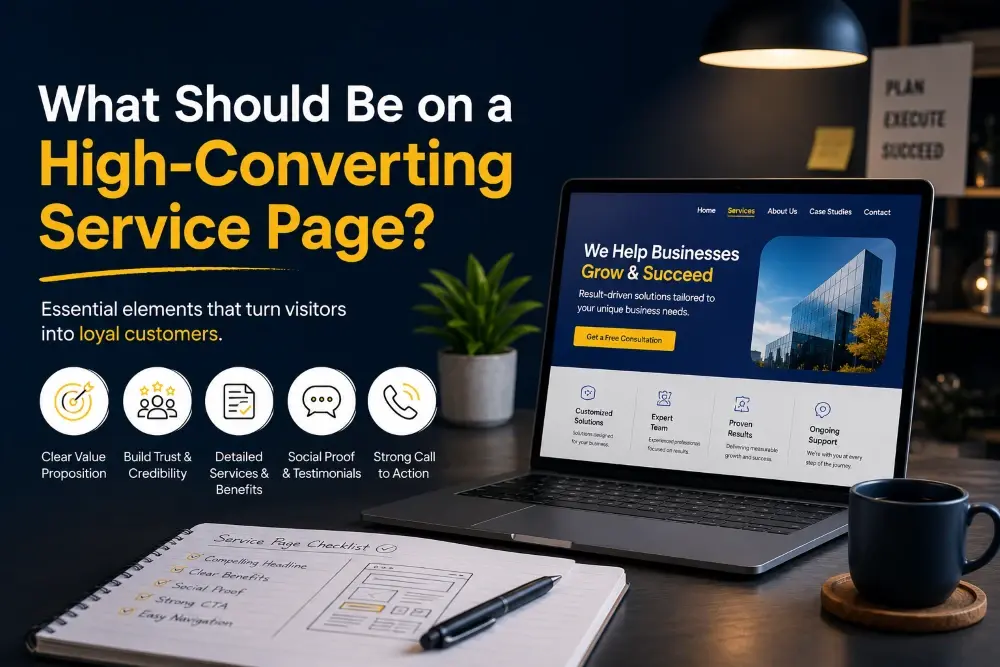
One service page's purpose is to convert a visitor into an enquiry. Not a blog reader. Not a scroller. A lead.
But most service pages are at a loss for this task. They sound more like a brochure, they talk about the business rather than the customer and hide the call to action too far away to be seen by the visitors.
When you're not sure how to improve your traffic and increase conversions, it's likely not that it's not your service. It's your page.
"If you're still figuring out the bigger picture, start with Why Is Your Website Getting Traffic but No Leads? 15 Reasons then come back here to fix your service page specifically."
This guide explains what a high converting service page should look like, both structure and appearance as well as the SEO that your page will rank and convert.
First, it's useful to know what doesn't work, before you get into what does.
Typical errors on poor performing service pages are:
There is no such thing as a service page SEO strategy and a conversion strategy. Search engines like pages that they can help the user and users convert on pages that feel clear, credible and easy to act on. Make sure you get the structure right, and you achieve two ends at once.
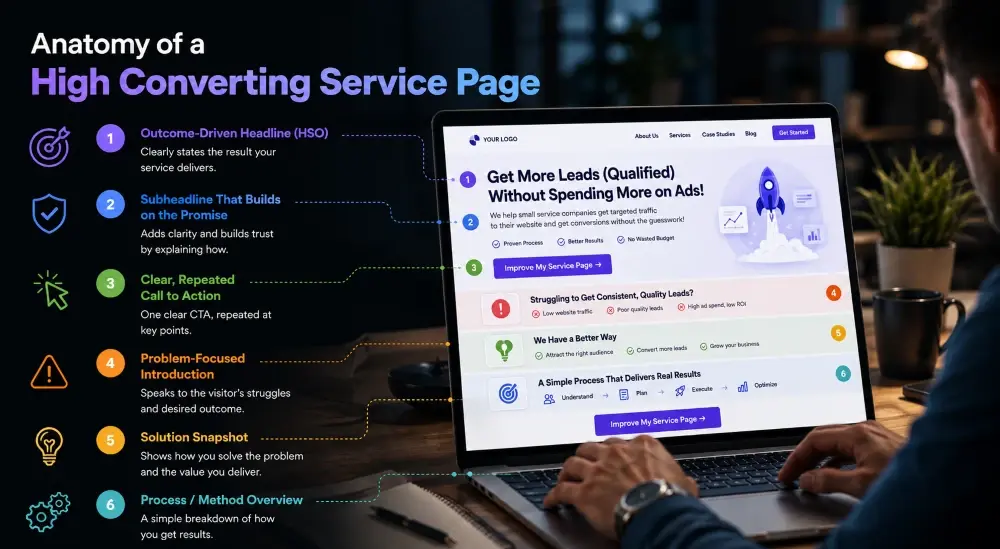
Consider using layers in your page. Each layer is there to perform a task before the visitor is able to scroll to the next section.
Don't say what type of service you provide in your headline. It should explain what happens to be the outcome.
Instead of:
"Digital Marketing Services"
Try:
Get More Leads (Qualified) Without Spending More on Ads!
There are three things that a strong headline should do:
It's also a good place to include your main keyword and helps with SEO of your service page as well as first impression conversions.
The subheadline should provide details to support the headline; the who, how, or what is different.
Example:
We help small service companies get targeted traffic to their website and get conversions without the guess work!
Each high converting service page should have one call to action, and it should be repeated at logical time intervals — not five different, competing buttons.
Best practice:
One of the goals of this site is to not leave visitors to our site to guess what to do next. The trail should be self-explanatory.
Talk about the visitor's situation, before talking about your service.
A good intro addresses:
This is one of the most important points to remember during service page copywriting – as you build up the emotional relevance before introducing your solution.
After gaining the reader's confidence, the page should develop trust and clarity in a logical flow.
In addition to a list of services – briefly describe each service, what it contains, and who it is for.
For example:
This is a great way for both your users and search engines to know what you are offering, and can help to strengthen the topical relevance for service page SEO.
Uncertainty kills conversions. Remove friction and demonstrate what happens after an individual reaches out to you with a simple 3-5 step process section.
Example structure:
Do not use more than one line for each step. This isn't the time to be specific, it's the time to be reassuring.
This is frequently the one most powerful levers to conversion on service pages. As many of these as apply actually to the item:
Specifics are better than generalities. We're getting better results than "we increased bookings by 42% in 90 days.
Each visitor is vehemently against clicking your CTA. Common ones include:
Go right to the point and mention these in brief paragraphs or in FAQ. If you communicate the objection aloud, you'll feel that people are being understood therefore, people are converted.
Beauty lies in the eyes of the beholder, and a page can be really nice and good to read, and yet not be understood and rank by the search engines. Cover these fundamentals:
Here, too, the variations in meaning are of importance. Of course, it's important to stick in phrases such as the service page optimisation, converting landing page and lead generation page to help search engines understand the topic of the page, but without bombardment.
Words aren't the only things that get converted. There is also weight to be given to the layout.
An easy-to-scan page will help to keep visitors on the page, long enough to reach your call to action.
There are two reasons for having a well-written FAQ page:
What is a service page vs. landing page?
Service pages are usually placed in a website's main navigation and are for a more general search intent, whereas landing pages are usually created for a campaign or ad. A service page should be optimised to convert as well, but will also need to be optimised organically over time.
What is the ideal length of time for a service page?
Usually 800 to 1,500 words long, long enough to address all the objections and to establish trust.But, every section should have a purpose and usually be between 800 and 1,500 words. The length needs to be added when it's needed, rather than when it's not.
Should each service be assigned a page of its own?
In most cases, yes. Each service can have or target specific webpage designed with specific keywords and talk directly to the service's target customer, thereby improving rankings and conversions.
What should the Call to Action be?
Minimally: above the fold, after the proof section and at the end of the page. Don't worry about repeating a conversion, be afraid of hesitation.
Are there times when it is not beneficial to include more trust signals?
Not if they're not true and applicable. Brands with a few solid and specific proof points excel over a wall of vague logos and star ratings.
There is no one trick to a high converting service page; it is constructed based on structure. A catchy title, a problem-first opening, a transparent explanation of your services, tangible evidence and an obvious call to action.
Continue to add on the solid onpage SEO and the same page that converts visitors to leads will continue to deliver organic visibility and lead more visitors to your website.
Your current service page may be lacking in one or more of these, which suggests you're missing conversions.
"Ready to turn your service page into a lead-generating asset? Visit us at Pansofic Solutions."

 Seo Admin
Jan 21, 2026
 Seo Admin
Nov 07, 2025
 Seo Admin
Apr 17, 2026
 Seo Admin
Dec 24, 2025
 Seo Admin
Jan 30, 2026