
Get a Customized Solution for Your IT Needs
+91 702-705-8777
info@pansofic.com
55-56, 1st floor, Chandigarh Complex, Prabhu Prem Puram, Ambala Cantt, Haryana 133006






"Website traffic but no leads? Explore 15 reasons for low conversions — from weak CTAs to trust issues — and practical fixes for each."
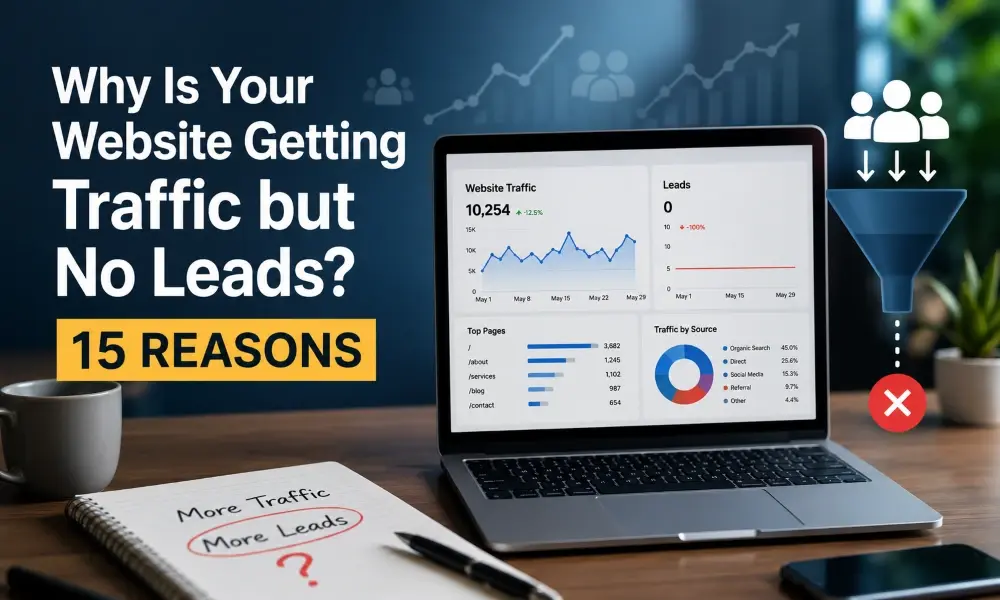
You're looking at your analytics and it looks like you have some good numbers. You're attracting visitors to your site on a daily basis. However, your inbox is empty, you don't get any phone calls and the contact form stays empty. If you are familiar with this, you're suffering one of the most common and most aggravating issues in digital marketing: website traffic no leads.
Traffic is just 50% of the solution. You may get hundreds of visitors to your website and not a single enquiry. In this guide, we'll discuss 15 reasons that this might be happening, the signs of this, and what you can do to correct the issue — even if it's time to call in a second set of eyes and get some website audit support to fix it.
The assumption is that there will be more business if there are more visitors. In fact, traffic only counts heads that come along. It doesn't indicate if they believe in you, comprehend your proposal, or are ready to proceed.
When a website isn't generating leads, it typically indicates a connection between the traffic being attracted and the conversion rate.Well, when a website is not generating leads, it is generally a problem between the traffic going and the ones converting. It may be a problem with your message, your design, your targeting, or technical set up. Let's take a look at the top scapegoats.
If you're looking to boost your leads by improving your website's conversion rate, the following 15 reasons should get your attention.
Not all traffic is created equal. You'll have lots of visitors, but not many enquiries, if you are attracting traffic from keywords, ads and social media that aren't relevant to what you're selling.
The visitors make their decision in seconds whether a page is relevant to them or not. When they don't immediately get the idea of what you do, who you help, and why you're different, they are going to look elsewhere.
The question is when you should make your home page and landing pages answer:
Everything is very informative and there's no actionable steps given, which leaves visitors without a clue. The call to action for all key pages should be clear, precise and not be merely a "Learn More" button at the bottom of the page.
Page speed is a direct impact on conversions. Visitors don't wait longer than a few seconds for your site to load and if it does, they will tend to leave before they see your offer. This is particularly harmful on a mobile device where the tolerance for that is even shorter.
If you have a significant number of mobile users visiting your website, and your site is not optimised for smaller screens, then you're likely losing leads that you could gain by having a nice, easy-to-navigate site. Too small buttons, text requiring zooming and slow loading images all drive visitors away.
Visitors will not stay and hunt for information or the page that they want if they can't easily locate it. Too many menu items, too many options, or too many paths to navigate around a site, all result in lost leads.
One has to be reassured before giving out contact information. Even if a visitor is interested in a business or service, he or she might be reluctant to commit if there are no visible indicators of trust.
Some typical signs of trust are:
Each additional field on a form, is an opportunity for somebody to drop. Too much information at the beginning is causing friction, right where it's needed for ease.
Sometimes, visitors are interested, but not quite ready to call or to get a quote. If doesn't have a lower commitment alternative (such as a downloadable guide, a checklist or an invitation to Get Free Website Audit) then you could be losing out on people who would have converted with a smaller initial commitment.
When a user is looking for general information and ends up on a page that is all about a sales pitch, it's not a good fit. The content should match up with what the visitor is more looking for during this time in their journey.
Thin content, generic or outdated content does not earn confidence. If you have not updated your pages for years, or they sound like they were written for the search engine and not readers, visitors notice — and leave.
Many business owners don't realise that design is important. If your service quality is top-notch but you lack a solid layout, branding or visual style, it can slip away and negatively impact credibility.
But by seeing only overall traffic figures you may be losing the visitors where you don't want them to go. If there is no tracking information for the forms, calls and important page interactions, then it is hard to pinpoint the problem.
In some instances there is a technical issue:
It can take months for these issues to be overlooked, and costing you leads every day.
Far too many companies are not taking the time to consider their entire site. When you're so close to your website you can't see the wood for the trees. That's where a professional review like Getting Free Website Audit comes in handy as you might miss some things on your own.
What could be stopping your website will only be known when you understand it, and then you must take action to overcome it. The steps to begin converting people's attention into real enquiries.
Always check your analytics before making any changes. Find pages which get traffic but low engagement, drop off pages, and bottom performing devices. This will give you a clue where to start your effort first.
Minimize the number of steps from a visitor's arrival to site to action. The fewer clicks, the shorter forms and the clearer paths all contribute to improved website conversions without the need for increased traffic.
Ensure that every key page resonates with your offer, your audience and your unique value. Don't use jargon or other terms that aren't familiar to a general audience.
Visitors should feel confident that you're a real, trusted business and not a fraud by reading reviews, real photos, certifications and testimonials of your team or work.
Improving conversion is no easy task. Experiment with headlines, calls to action and page layouts on a regular basis, and track your results to determine which ones are most effective for your unique target market.
When changes have been made and you still don't get the results, it's time to get the outside eye. If you opt for support for a Free Website Audit, you can discover issues you may not have considered – be they technical or messaging issues – and get a clear action plan you can follow to do better.
Don't know how much you should be looking at? If any of the following apply to your website, you should consider a website audit:
It can take a bit of time for new websites to establish themselves and gain search authority, and, to get sufficient traffic so as to be able to find any patterns. You can reasonably wait a couple of months to make a judgment, if there are any obvious issues with the technology or the messages, then they need to be corrected immediately, and not waited out.
Organic visitors, Google ad clicks, social media and referrals are often different kinds of visitors. Some sources bring people who are prepared to enquire, others bring casual browsers. If you compare the conversion rates by traffic source, you will easily be able to find out which traffic source is more efficient than the others.
Heatmaps, session recordings and funnel reports in analytics can provide insight into how exactly visitors are losing interest or leaving a page, rather than merely the number of visitors.
Sometimes, a complete redesign is not required. Changes to your busiest or most valuable pages (like your homepage, service or contact page) can yield quicker results than a comprehensive redesign.
Yes. A lot of conversion problems won't show themselves on the surface — slow loading, broken tracking, and minor trust issues are just a few of the myriad problems that can only manifest themselves during a proper review. If you elect to use the Get Free Website Audit support, you might discover problems that would not be apparent from the front end.
A general audit every few months is fair practice, and a more detailed audit should be performed when there's been a significant change in traffic and lead volumes.
One of the most frequent problems is that a website might be seeing consistent traffic, but not converting any leads. However, this is not always the case. The problem typically is associated with a few easily correctable issues, such as, unclear messaging, insufficient trust signals, technical friction, or failed to match between visitors' expectations and your site's offerings.
Examine your own site in light of the 15 reasons listed above and you'll come up with a list of your own. And if you want some unbiased, expert advice on what you're doing wrong with your conversions, it's a smart move to get Free Website Audit support next.

 Seo Admin
Jan 21, 2026
 Seo Admin
Nov 07, 2025
 Seo Admin
Apr 17, 2026
 Seo Admin
Dec 24, 2025
 Seo Admin
Jan 30, 2026