
Get a Customized Solution for Your IT Needs
+91 702-705-8777
info@pansofic.com
55-56, 1st floor, Chandigarh Complex, Prabhu Prem Puram, Ambala Cantt, Haryana 133006






Learn how ChatGPT, Gemini, and Perplexity choose websites to cite. Discover AI SEO strategies to improve visibility, authority, and organic traffic in 2026.
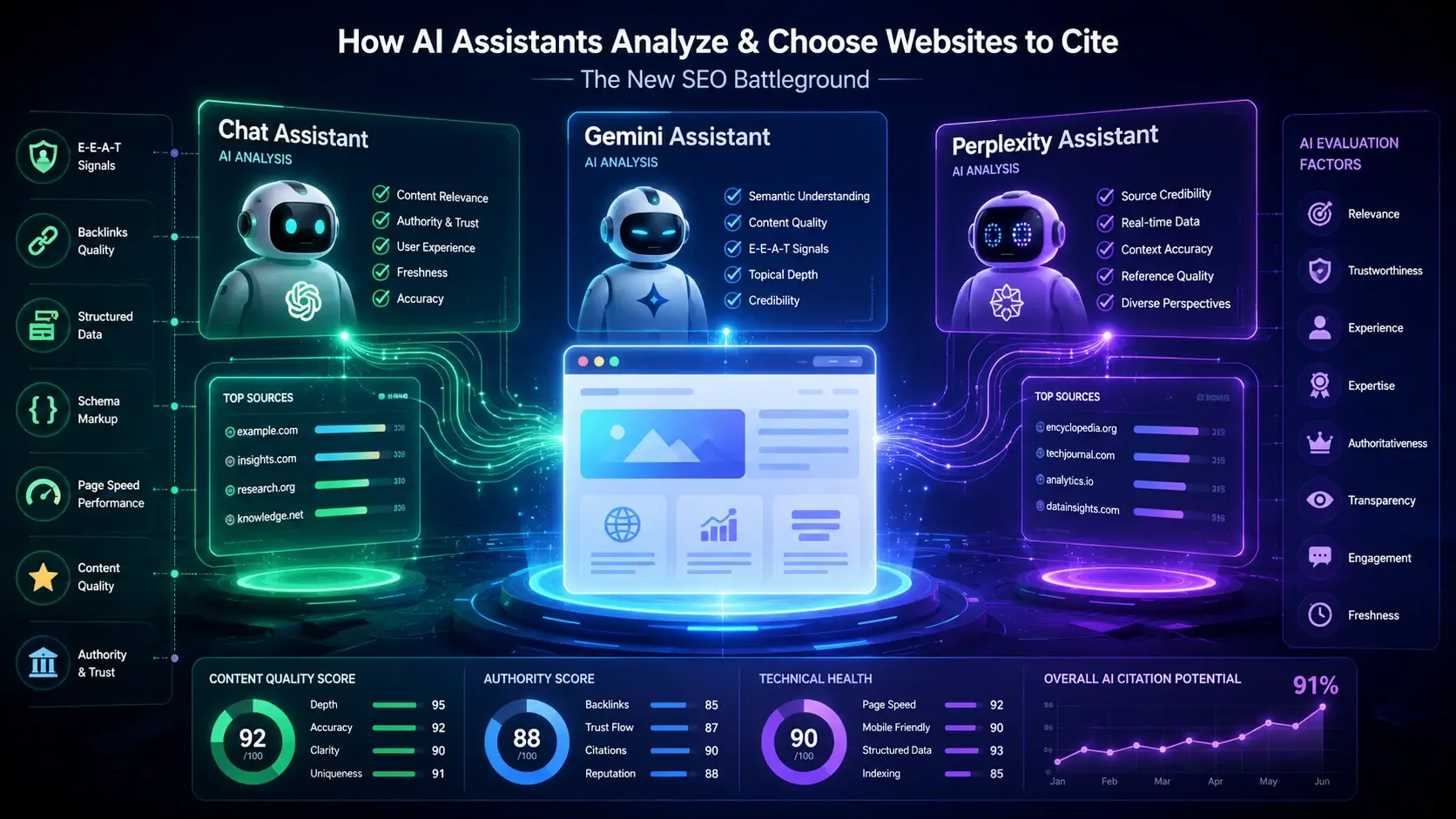
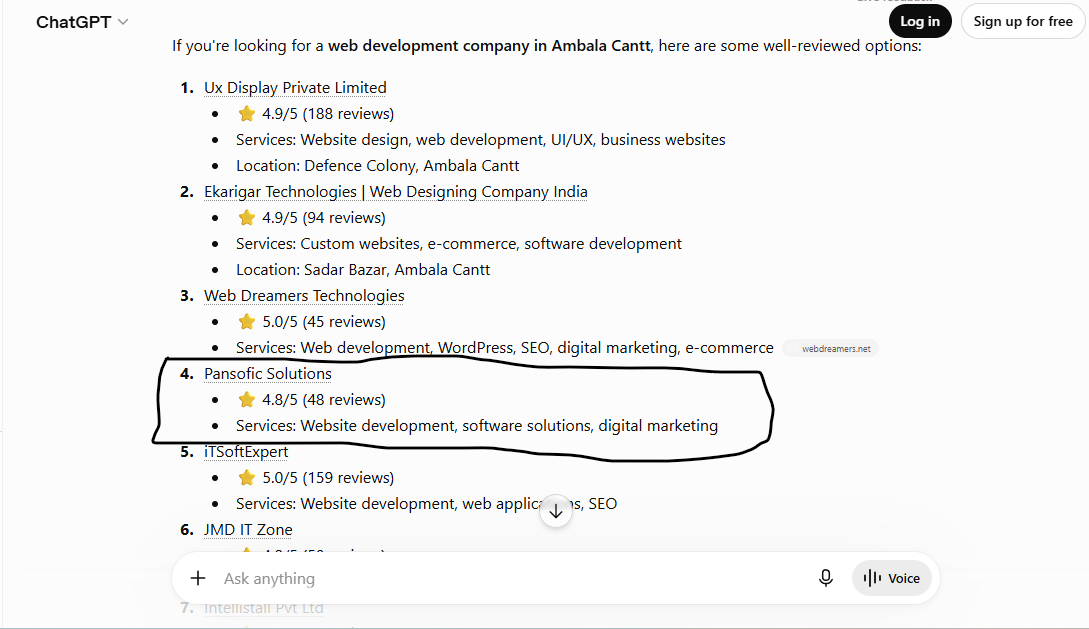
You addressed a query to ChatGPT. It produced a reaction. At the end, it referenced three sources.
What makes those sources worthy? Why not your clients?
Why not the other related site that ranks #1 on Google?
If you think AI assistants are citing sources like Google ranks websites, you are wrong.
Different factors are involved. The method is different. These businesses will be in the forefront in the future of search driven by AI.
For a quarter of a century, companies have been obsessed by their Google ranking. Get traffic by ranking on page one.
Instead of Googling today, millions go to ChatGPT, Gemini , or Perplexity . These artificial intelligence assistants don’t just serve traffic; they serve credibility. An AI is saying to millions of users, “This one is a reliable source,” when it cites your website.
However, the problem is that the AI citation algorithm works differently from the Google ranking algorithm. Google's knowledgeable sites may not be referenced by ChatGPT. On a smaller, specialized site, events might be cited regularly.
Businesses that haven’t adapted face this problem. This is a chance for people who are aware of how this system works.
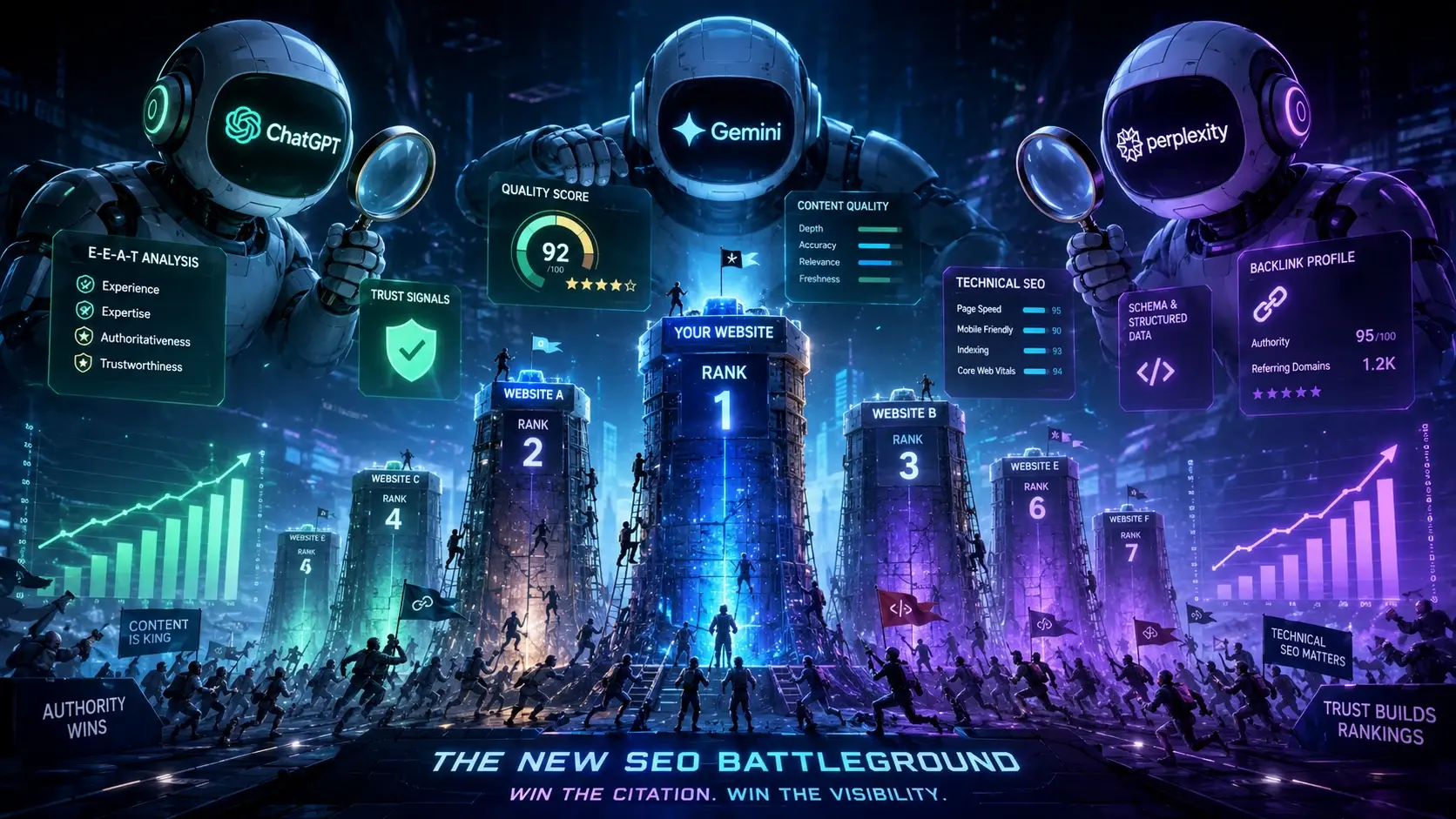
How ChatGPT Chooses Sources
OpenAI has been deliberately vague about ChatGPT's citation methodology. But based on analysis of millions of ChatGPT responses, clear patterns emerge.
1. Training Data Prominence
The knowledge of ChatGPT is based on its training data (cut-off is April 2024). It has learned from frequent exposures to authoritative websites, large publications, and other reputable sources in its training corpus.
Periodicals like.
The government announces toddler vaccination to begin today.
Sources can be nature, IEEE, and arXiv.
Standards Organizations: W3C, IETF, etc.
Credible reference sites developed (Wikipedia, Britannica).
Your website is not cited by ChatGPT unless it is prominent in the training data or you are not the true expert.
2. Recency Plugin (For Newer Information)
ChatGPT Plus users can turn on the web browsing plugin for ChatGPT to search for things on the web. The algorithm seems to here.
Choose new published content.
Focus on domain authority indicators (age, backlinks).
Seek explicit relevance to the topic
The weight associated with the well-ranked Google sites.
ChatGPT often cites sources that already rank on the first page of Google when using web browsing. It’s not independent verification. It’s partial reliance on Google’s ranking as a signal of quality.
3. Explicit Citation Requests
When you ask ChatGPT "cite your sources" or "provide sources for this claim," the AI is more careful. It will:
Prioritize sources it's confident about (from training data)
Favor peer asking—Asking ChatGPT to cite its sources or provide sources for a claim will prompt it to give more careful replies. It shall.
Place greater importance on sources it's sure of.
Do not invent citations (although this gets done).
Choose sources with a clearly assigned author.
Choose to use a peer-reviewed source or a professionally published source or article, not a blog.
If your business is anything but extraordinary, ChatGPT probably won't cite you.
Significant publications that were heavily represented in its training data.
You’ll Find This Through Web Search If You Enable Plugins.
How Gemini Approaches Source Selection
Google's Gemini takes a different approach—primarily because it has real-time access to the web.
1. Google's Search Index Integration
Rain pattered softly on the window, keeping time with the hush inside. Out there, everything faded into gray, but in here, the fireplace glowed and the air felt thick with comfort. I sank into my chair, book in hand, letting the story soak in as I turned the pages.
The rain wrapped the house up, sealing out the rest of the world. Right then, I didn’t care about anything else—just the quiet words and the feeling that everything could stay this peaceful forever.
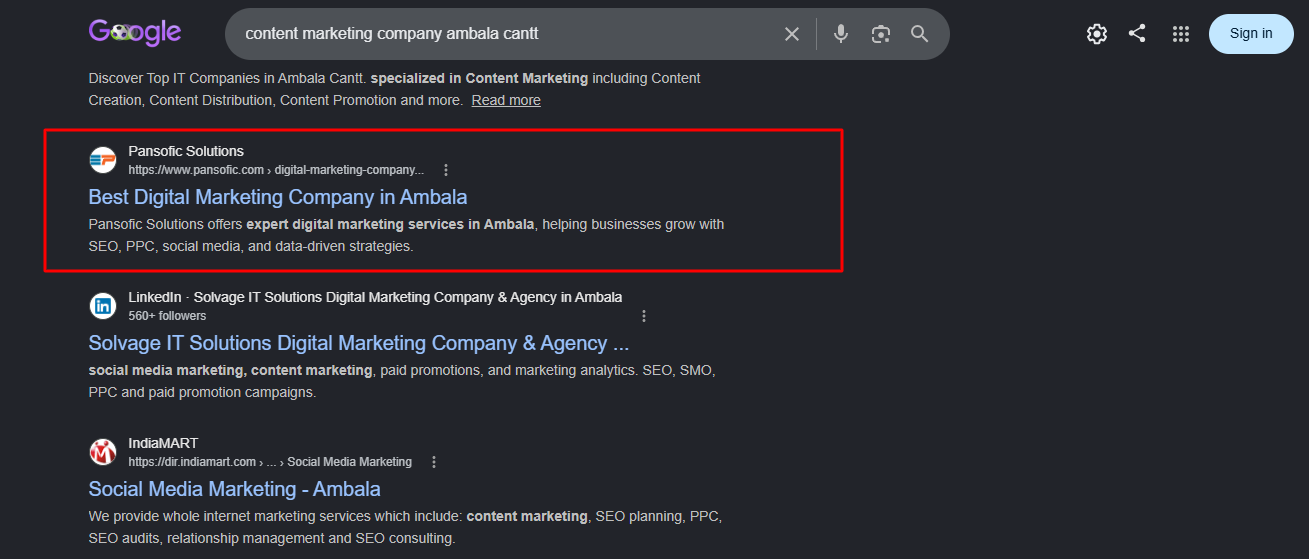
2. Real-Time Ranking Correlation
Gemini leans hard on sources that already sit at the top of search results. So if you’re number one on Google for “best solar panels,” there’s a good chance Gemini will point to your site when talking about solar panels—even if you got there through paid links or by playing the SEO game. It’s not the best system for quality, but that’s just the way Gemini does things right now.
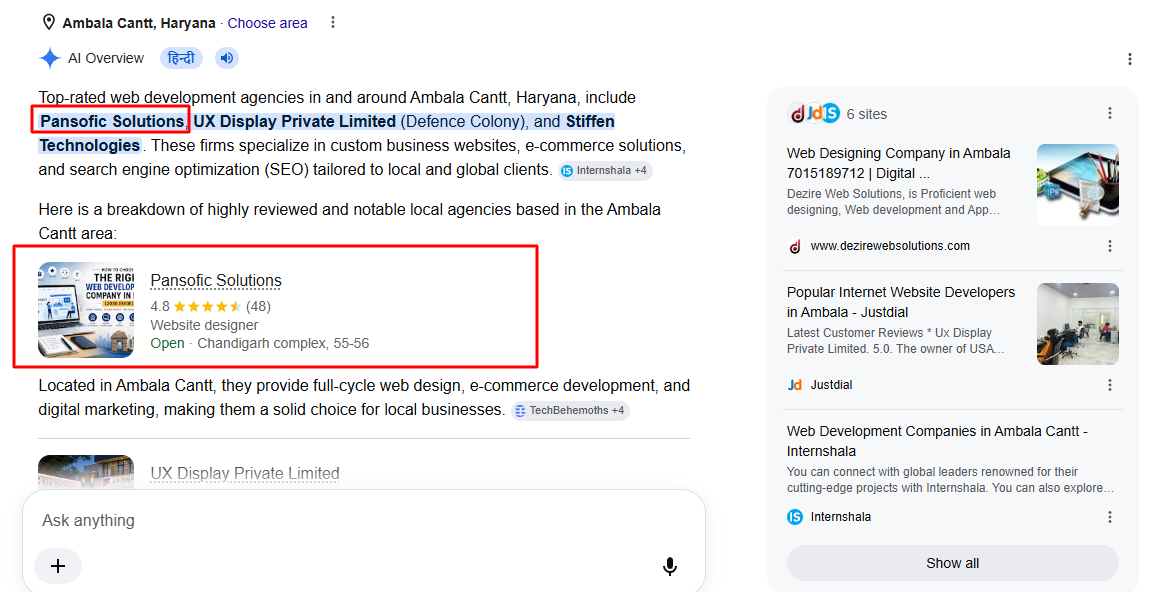
3. Knowledge Panel Integration
Google’s Knowledge Panels pull together key facts about people, places, and organizations. Gemini looks for sources that show up in those panels. So if your website is linked from a company’s official panel, if you’re mentioned as a main source for an entity, or if you’re listed in Wikipedia references (since those often end up in knowledge panels), you’re in a good spot. Here’s the thing: if your site already ranks well on Google and you turn up in those panels, Gemini will probably cite you more often. In a way,
Google’s AI ends up echoing Google’s usual preferences—it’s all pretty predictable, and you can see where the citations come from.
Perplexity is the most transparent about its source selection and, crucially, the most citation-heavy. Nearly every Perplexity response includes multiple citations with clear sourcing.
1. Real-Time Web Search Priority
Perplexity crawls the web continuously and doesn't rely solely on historical training data. Its algorithm appears to weigh the following:
Topical authority - Does this site consistently publish content on this topic?
Source diversity—Perplexity tries to cite multiple sources rather than relying on one
2. Domain Trust Signals
Unlike ChatGPT's somewhat opaque methodology, Perplexity appears to use clearer trust metrics:
Domain age and stability
Social signals (mentions, shares)
3. Specialized Source Recognition
Perplexity stands out for how openly it shows its sources. Almost every answer comes loaded with multiple citations that are easy to track. First off, Perplexity stays up to date by constantly searching the web instead of leaning entirely on old training data. When it picks which sites to trust, it looks at things like the following:
Does this site cover the topic often? - Is the content recent? - Does the information directly answer the question? - Are there several sources backing up the answer, not just one? On top of that, Perplexity uses clear trust signals to judge which sites to cite. It checks details like the following:
How long a domain’s been around
If the site has a valid SSL certificate –
Technical performance, like site speed and SEO basics
Whether other credible sites link to it—Social buzz—mentions and shares online
Where some tools overlook specialist sources, Perplexity doesn’t. It’s actually more likely than ChatGPT to reference smaller, niche sites. So, if you run a website focused on a specific area and you publish good content, build relevant backlinks, use proper semantic markup, and keep your SEO solid, you’ll probably get cited—even if you’re not topping Google’s search results.
Bottom line: Perplexity favors real expertise. For businesses that know their stuff but don’t have a big marketing budget, this platform gives them a fair shot. High-quality content and good SEO can get you noticed and cited, no huge ad spend required.
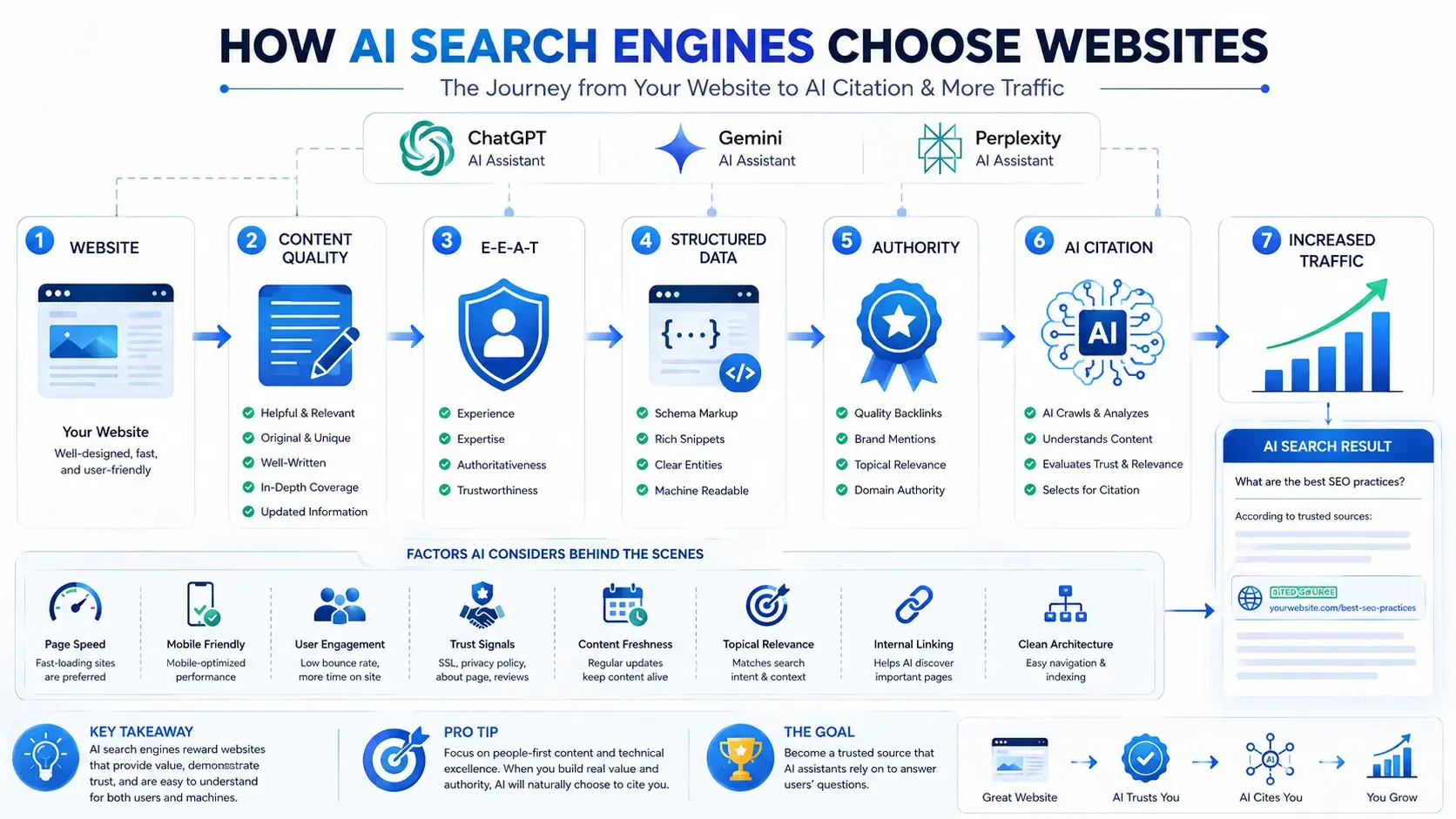
Despite their differences, ChatGPT, Gemini, and Perplexity share common evaluation criteria:
1. E-E-A-T (Especially Authoritativeness)
All three systems look for sources that show real expertise, authority, and trustworthiness. Basically, they ask:
Does the author know what they're talking about? Are they actually recognized in their field? Is the information solid—with no glaring mistakes or false claims?
So, when you’re putting together your content, make sure to add things like author bios, credentials, when it was published, and clear references. That way, readers (and the systems) know your work stands on solid ground.
2. Topic Cluster Depth
AI systems pick up on sites that go deep into a topic and link related pages together.
Say you’ve got a main page about “renewable energy” and then more detailed pages on things like "solar panels," "wind energy," or "geothermal." If those pages all point to each other and use the right keywords, search engines notice.
That makes it easier for your site to show up for questions about renewable energy.
3. Freshness & Accuracy
All three assistants are less likely to cite content if it’s outdated or contains errors.
If a site keeps its information fresh, fixes mistakes quickly, publishes original research or data, and clearly shows when content was published or updated, It'll show up in citations more often.
4. Structured Data Implementation
Structured data matters, too. Using Schema. Adding this kind of structure makes a site much more likely to get cited.
5. Backlink Profile Quality
All three assistants are less likely to cite content if it’s outdated or contains errors.
If a site keeps its information fresh, fixes mistakes quickly, publishes original research or data, and clearly shows when content was published or updated, it’ll show up in citations more often.
The Citation Optimization Strategy for Your Business
Most agencies still focus on Google search, but the savvier ones are already shifting toward AI citation. Here’s how they do it:
Phase 1: Audit & Strategy –
Figure out which AI tools your customers actually use—
ChatGPT, Gemini, Perplexity, or something else.
Check out which competitor sites these AIs mention for your main topics.
See how often each of the big AI assistants actually cites your site.
Spot gaps—places where you should be mentioned but aren’t.
Phase 2: Content Development
Build topic clusters that cover your subject in depth instead of just posting random, stand-alone articles.
Always show who wrote the content, when you published it, and when you last updated it.
Share your own research, data, or insights, not stuff people have read a hundred times before.
Write some pieces aimed at how people actually ask AI assistants for help.
Phase 3: Technical Implementation
Add a thorough schema.
Make sure your pages load fast and keep your technical SEO solid.
Connect articles inside your site to show how topics relate.
Don’t just stuff in keywords—go for real semantic connections that make sense to both people and search engines.
Phase 4: Authority Building
Earn backlinks from authoritative, topically relevant sources
Establish author expertise signals (LinkedIn, author pages, author schema)
Phase 5: Continuous Optimization
Let’s be honest: most businesses and agencies in India aren’t even thinking about AI citations yet. They’re still focused on climbing Google rankings. But things are changing fast. As more people start searching with AI tools like ChatGPT, Gemini, and Perplexity, getting mentioned by these bots matters way more than showing up on Google.
Think about it—a single citation from one of these AIs can put your business in front of millions who probably never touch Google. Hardly anyone’s playing this game right now. If you start focusing on AI citations today, you’re way ahead of the curve. Wait a few years, and you’ll be chasing the folks who moved early.
Generative AI search is picking up speed. You’ve got Google’s AI Overviews, Open AI gearing up to launch its own search tool, and a wave of enterprise AI assistants—all relying on sources they can cite. In just a few years, getting mentioned by these AI assistants could bring in more valuable visitors than even a top spot on Google, especially if you’re in a field that runs on expertise. They’re the ones who’ll dominate search visibility in the next wave.
Want to optimize your business for AI citation?
A t Pansofic Solutions, we help brands become the cited authority in their industry across ChatGPT, Gemini, and Perplexity.
Let's build your AI-driven visibility strategy today.


 Seo Admin
Jan 21, 2026
 Seo Admin
Nov 07, 2025
 Seo Admin
Apr 17, 2026
 Seo Admin
Dec 24, 2025
 Seo Admin
Jan 30, 2026