
Get a Customized Solution for Your IT Needs
+91 702-705-8777
info@pansofic.com
55-56, 1st floor, Chandigarh Complex, Prabhu Prem Puram, Ambala Cantt, Haryana 133006






Learn how to make your business information easier for AI search to understand. 8 simple AI SEO steps to help AI tools find, trust and recommend your business.
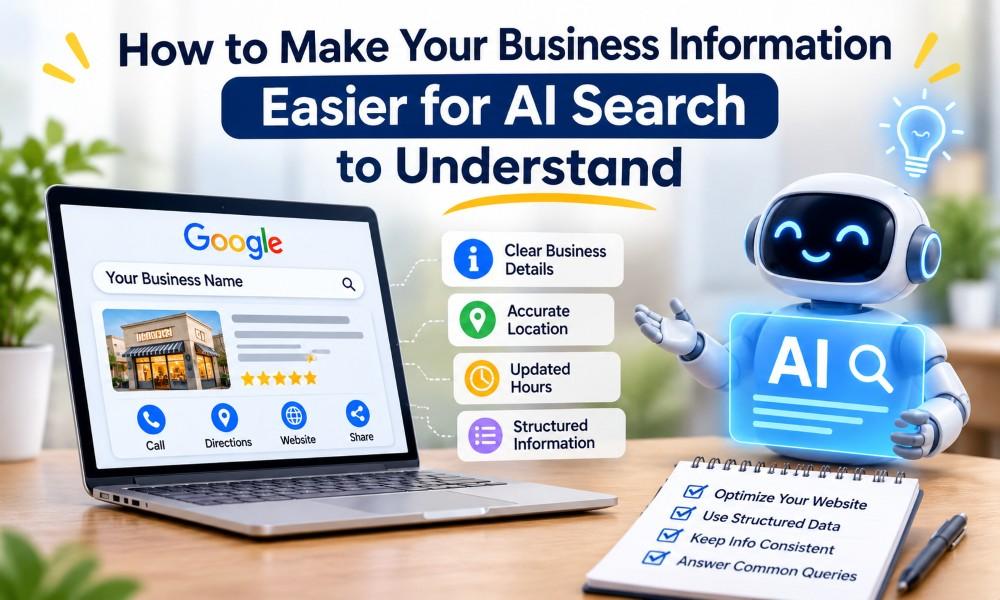
People are no longer just typing search terms into a search bar. They ask complete questions to ChatGPT, Google AI Overviews, Perplexity and Copilot. These tools read, summarise and suggest. If they don't fully grasp your business, they will bypass you and suggest another option.
Fortunately, there's a solution. The key to making your business information easier for AI search to understand is to be clear, consistent and organised.
This guide explains AI search optimization in simple, plain English. You'll discover what AI-readable business information is and how to create it.
AI-readable business information is content that an AI can read easily. It tells AI tools who you are, what you do, where you work and who you help.
Think of an AI tool as a very fast researcher. It scans many sources, compares them and selects answers that seem reliable. If your information is confusing, or if it doesn't agree across sources, the researcher moves on to someone else.
There are three characteristics to keep in mind when creating AI-friendly content:
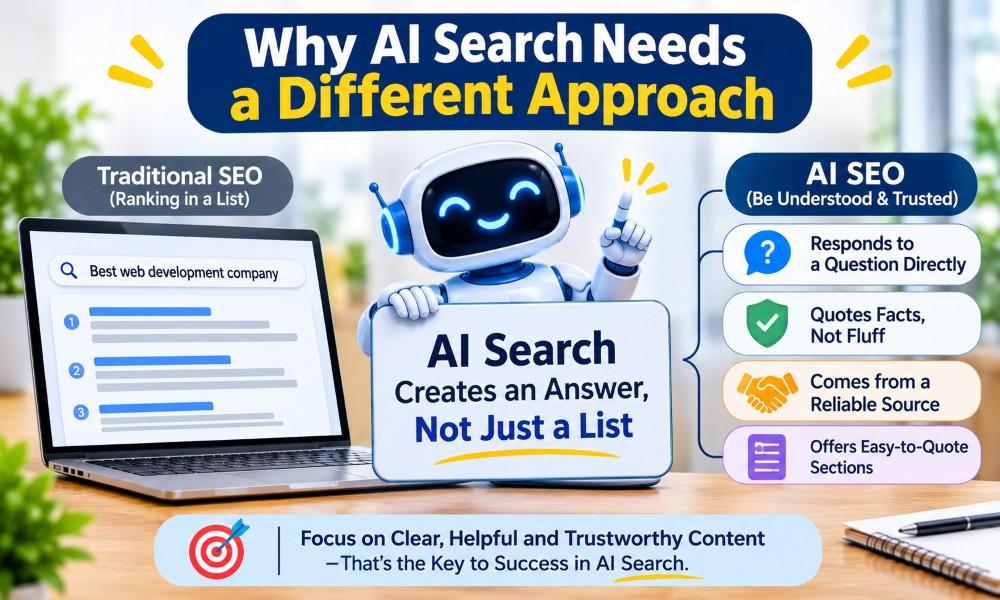
In the past, SEO was all about ranking a page in a list of links. AI search creates an answer, often from multiple sources, and mentions only a few businesses.
If you want to be one of them, see our guide on how a small business can appear in ChatGPT recommendations.
This changes the objective. Ranking is still important, but you also need to be understood and trusted. That's where AI SEO, also known as generative engine optimization, comes into play.
To understand how this shift affects your business, read our guide, AI Search vs Google Search, What Indian Businesses Need to Know.
AI tools look for content that:
If your website is full of marketing "fluff," AI has very little to quote.
AI tools don't visit your business or call you with questions. They only know what they can find online. When the information they find is limited or contradictory, they fill the gap with their own guesses.
This typically happens for a few simple reasons:
AI tends to play safe when information is unclear, and it will suggest a business whose details are easier to verify. AI-readable business information takes away that uncertainty.
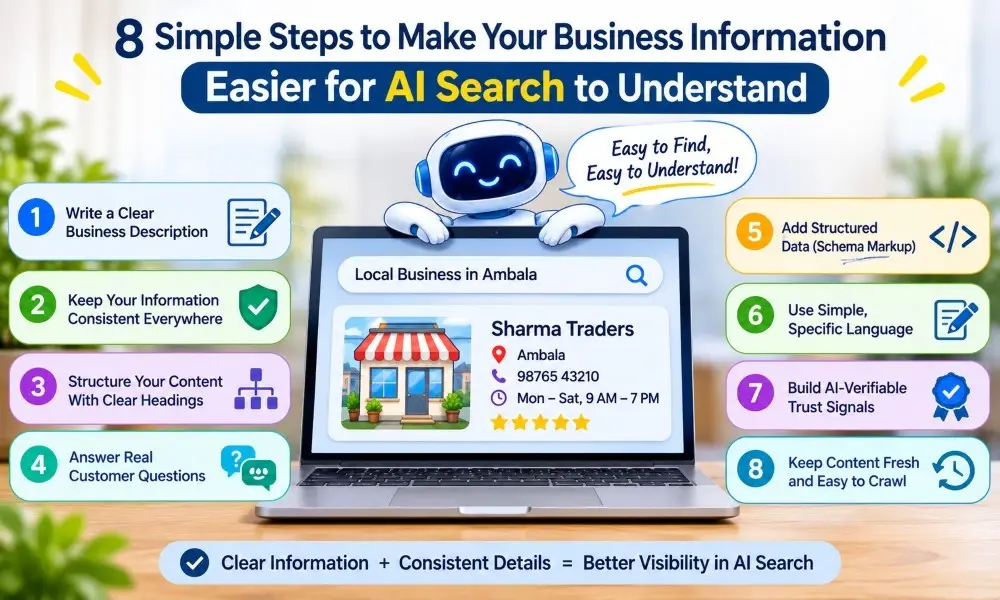
Use one simple sentence to tell people what your business does. Put it on your home page and About page.
A weak example: "We provide innovative solutions for tomorrow's problems."
A strong example: "We are a website development company in Ambala that builds business websites for local shops, clinics and service providers."
The strong version names the service, the place and the audience. An AI tool can use it immediately.
To help you with the description, here are some tips:
Let's look at a hypothetical dental practice in Ambala and compare the two versions.
"We deliver world-class dental care with a passion for smiles!"
An AI tool can't identify where the clinic is, what treatments it provides or who it serves.
"Smile Care Dental Clinic is a dental clinic in Ambala Cantt that provides root canal treatment, teeth cleaning, braces and dental implants. We are open Monday to Saturday, 10 am to 7 pm. Please call us or book a consultation."
The strong version identifies the location, treatments, hours and next step. Every fact is easy to quote, and each can answer a question such as "dentist in Ambala for root canal."
This method suits all local businesses, whether it's a coaching centre, a hardware store or a hair salon.
AI tools validate information across sources. They lose confidence if your website says "Sharma Traders" while a business directory lists you as "Sharma Trading Co."
Check these details on all platforms:
Check your website, Google Business Profile, social media and directory profiles. Fix every mismatch. This one step alone can improve how AI describes a business.
Headings serve as signposts for both humans and machines. On a well-structured page, AI can locate the right answer quickly.
Here are a few basic guidelines:
A service page might have headings such as "What Is Included in Our Website Design Service?" and "How Long Does a Website Project Take?" These imitate the way people ask AI tools for information.
AI search is focused on questions. The more closely your content answers them, the higher the chances of it being used.
Write down the questions your customers ask on calls, in emails and on WhatsApp. Write a two- or three-sentence answer to each of them on your website. Place the answer immediately after the question, not behind a lengthy introduction.
Structured data is a small piece of code that labels your information for machines. It tells search engines: this is a business name, this is a telephone number, this is a service.
For most businesses, these schema types are useful:
Schema does not guarantee that AI will recommend you. It removes guesswork and reduces the risk of miscommunication. WordPress plugins can assist, but a developer can set it up with much more precision.
AI models handle plain language better than clever wording. Short sentences are easier to summarise and quote.
Try these habits:
Also use semantic variations naturally. For instance, you can use phrases such as "AI search optimization," "AI SEO," "optimising for AI search tools" and "AI-friendly content" across your pages. This lets machines see the whole topic without you repeating one phrase again and again.
AI tools tend to gravitate towards credible sources. Use solid evidence:
Don't make up reviews or exaggerate results. AI systems and customers both need to be able to rely on authentic proof.
Outdated information confuses AI tools. You don't want to be described wrongly because your hours changed but your site still shows the old ones. Follow a simple routine:
Next, review the technical fundamentals, as even good content won't work if machines can't access it:
Even basic technical SEO affects AI visibility, as many AI tools rely on search indexes.
Use this list to quickly review your business:
If you tick fewer than six, there is room for improvement.
You don't need to fix everything in one week. Work in this order:
Typically, the biggest improvement for the least effort comes from steps 1 to 3. If you aren't sure what your site needs most, a professional review can save you time. Our Get AI Readiness Audit evaluates your website, listings and content to show how readable your site is to AI tools, and gives you a list of items to prioritise.
AI search rewards businesses that are easy to understand. There are no fussy tricks to use. Clear descriptions, consistent details, organised content, honest proof and a technically healthy website are what you need.
Start small. Finish your business description, align your information across platforms and answer your customers' most common questions. As more people rely on AI for recommendations, it's crucial to make your business information AI-readable, preferably early.
Want to find out where you stand? Get AI Readiness Audit from Pansofic Solutions and discover how well AI search tools understand your business today.
Don't aim to be long, aim to be clear. A short, focused page that answers a question well will outperform a lengthy page stuffed with filler. Give complete answers, then stop.
Yes, in most cases. A dedicated page for each main service gives AI tools a clear and precise source. Putting five services on one page makes it harder for AI to match you to a specific question.
Yes, with proper guidance and precautions, AI can help create business content. It's fine to use for drafts, but always check and edit. Add extra facts, local information and personal experience. If you publish generic AI-generated content, search engines have little reason to choose you.
They can, if properly labelled. Add descriptive alt text to images and use clear file names. Add captions or a transcript to videos. Machines read this text far better than they interpret pictures alone.
No. Small and local businesses can benefit a lot, because clear local information is exactly what AI tools look for when answering location-based questions. A tidy website and consistent listings can put a small business in front of new customers.

 Seo Admin
Jan 21, 2026
 Seo Admin
Nov 07, 2025
 Seo Admin
Apr 17, 2026
 Seo Admin
Dec 24, 2025
 Seo Admin
Jan 30, 2026