
Get a Customized Solution for Your IT Needs
+91 702-705-8777
info@pansofic.com
55-56, 1st floor, Chandigarh Complex, Prabhu Prem Puram, Ambala Cantt, Haryana 133006






Website agency vs freelancer? Compare cost, quality, SEO, support, development and scalability to choose the right option for your business.
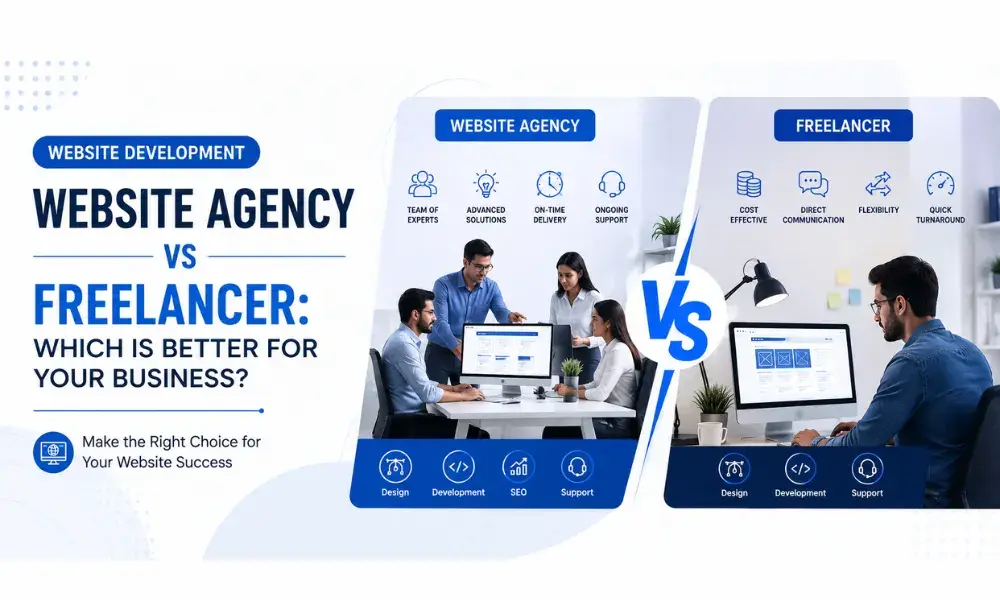
When you're planning a new website for your business, one of the first decisions you'll have to make is who should build it.
Should you hire a freelancer or work with a professional website development agency?
You will probably find both options while searching online. Freelancers may offer attractive prices and direct communication, while agencies usually present themselves as a complete team that can handle design, development, SEO and other digital requirements.
So, which option is actually better?
The truth is that there is no single answer for every business. A freelancer can be an excellent choice for a simple website, while an agency may be more suitable for a growing business that needs custom development, SEO, eCommerce, integrations or ongoing support.
The right choice depends on your budget, project requirements, timeline and long-term goals.
The biggest difference is usually the way the project is handled.
When you hire a freelancer, you are generally working directly with one professional. That person may handle the design, development, communication and sometimes even basic SEO and maintenance.
With a website agency, the project is generally handled by a team. Depending on the agency, you may have access to designers, developers, SEO specialists, content professionals and project managers.
This doesn't mean an agency will always deliver better work than a freelancer. There are highly skilled freelancers who create excellent websites, just as there are agencies that may not be the right fit for a particular project.
The important thing is to look at experience, portfolio, process, communication and the actual scope of work.
In many cases, a freelancer may offer a lower initial quotation than an agency.
One reason is simple: a freelancer usually has fewer operating costs. They are working independently, so there may not be separate costs for project management, multiple employees, office infrastructure or different departments.
An agency, on the other hand, may have a team of designers, developers, SEO professionals and other specialists. Those resources can increase the project cost.
However, you shouldn't decide purely on price.
For example, imagine a freelancer quotes ₹30,000 for a basic five-page website, while an agency quotes ₹60,000 for a custom website with multiple service pages, SEO-friendly structure, lead-generation features and ongoing support.
The two quotations may look very different, but you're not actually comparing the same scope.
That's why the cheapest quotation isn't always the best value.
A freelancer can be a very practical option when your website requirements are straightforward.
Suppose you're a small local business, consultant, photographer, freelancer or new startup. You may only need a professional website with information about your business, your services, your location and a way for customers to contact you.
In this situation, hiring a skilled freelancer can make sense.
You may also enjoy direct communication because you're speaking directly with the person who is building your website. There are fewer people involved, which can make smaller projects easier to manage.
If your website doesn't require complicated functionality or multiple digital services, you may not need a full agency team.
The situation changes when your website becomes an important part of your business strategy.
For example, imagine you're running an eCommerce business and need payment gateway integration, product management, shipping integration, customer accounts and analytics.
Or perhaps you're running a service business and want your website to generate leads through Google. In that case, you may need SEO, dedicated service pages, landing pages, conversion-focused design, content and ongoing optimization.
These projects involve more than simply designing and developing a website.
An experienced agency can bring different skill sets together under one project, which can be useful when the website has several moving parts.
SEO is one area that businesses should think about before choosing their website development partner.
A website can be technically complete and still struggle to attract visitors from Google.
If organic traffic is important to your business, your website needs a strong foundation. Things such as page structure, URLs, headings, mobile responsiveness, page speed, internal linking and metadata should be considered during development.
A freelancer may have strong SEO knowledge, but you need to check their actual experience.
Similarly, don't assume that every agency automatically provides excellent SEO. Ask what they actually include in the project.
For example, does the quotation include only basic technical SEO, or are they also providing keyword research, content strategy, on-page optimization and ongoing SEO?
Always ask for the exact scope instead of assuming SEO is included.
There's no simple answer here either.
A talented freelancer can create a beautiful and professional website. At the same time, an experienced agency can provide access to dedicated UI/UX designers and a more structured design process.
Instead of deciding based on the word “agency” or “freelancer,” look at their previous work.
Open their portfolio and check how their websites look on mobile. Look at the navigation, typography, page structure, calls to action and overall user experience.
Most importantly, check whether they have experience creating websites similar to what your business actually needs.
A beautiful website isn't necessarily a successful website.
It should also be easy to use and should help visitors take the next step.
This is something many businesses don't consider at the beginning.
If you're working with one freelancer and that person becomes unavailable, your project could potentially be delayed.
It could happen because they're working on another project, dealing with personal commitments or simply have too many clients at the same time.
With an agency, there is generally a team behind the project. If one person isn't available, another team member may be able to continue the work.
Of course, this depends on how the agency operates. Not every agency has the same support system.
That's why you should ask about backup support and project continuity before signing an agreement.
Communication can actually be one of the biggest advantages of working with a freelancer.
You generally communicate directly with the developer, explain your requirements and receive updates from the same person.
For a small project, this can be very convenient.
With an agency, you may communicate with a project manager or account manager instead. The development team may work behind the scenes.
Some business owners prefer direct communication, while others prefer having a structured process where one person manages the project.
Neither approach is automatically better.
What matters is whether communication is clear, regular and organized.
If you're planning a simple online store, an experienced freelancer may be able to handle the project successfully.
But eCommerce websites can become complicated very quickly.
Once you start adding payment gateways, shipping systems, product variations, inventory management, customer accounts, discounts, advanced filters and third-party integrations, the project requires more planning and testing.
This is where an agency can be useful because different specialists can work on different parts of the project.
However, you should still evaluate the actual team and their eCommerce experience rather than assuming that every agency is automatically capable of handling complex stores.
A normal business website and a custom web application are two very different projects.
A business website mainly provides information and generates enquiries. A web application may have user accounts, dashboards, databases, APIs, booking systems or custom workflows.
For example, if you want to build a customer portal where users can log in, manage their information, make bookings and access documents, the development requirements become much more advanced.
These projects usually benefit from a structured development process involving frontend development, backend development, database management, testing and security.
For this type of project, having access to a development team can be a significant advantage.
This is one question you should always ask before hiring a developer.
Website development doesn't necessarily end when your website goes live.
Over time, you may need new pages, content updates, security updates, technical fixes, performance improvements or additional features.
You may also need help when something suddenly stops working.
Before choosing a freelancer or agency, ask about their post-launch support.
Find out whether maintenance is included, how long support is provided and what charges apply for future changes.
A clear understanding at the beginning can prevent a lot of confusion later.
If you're considering a freelancer, don't make your decision only because they offered the lowest price.
Start by checking their portfolio. Look at the websites they've actually built and see whether the quality matches what you're expecting.
You should also ask about the technology they plan to use, how long the project will take and what exactly is included in the quotation.
If SEO is important to you, ask about their SEO knowledge as well.
Most importantly, discuss ownership. Make sure you have appropriate access to your domain, hosting, CMS, website files and other important accounts.
The same principle applies when hiring an agency.
Don't choose an agency simply because it has a large portfolio or impressive-looking website.
Ask who will actually work on your project and what the development process looks like.
You should have a clear understanding of the number of pages, design scope, functionality, SEO work, integrations, timeline, revisions and support.
It's also worth asking what happens if you need additional features six months after launch.
A good development partner should be able to explain not only how the website will be launched but also how it can grow with your business.
Suppose you receive three quotations:
Freelancer – ₹25,000
Agency A – ₹50,000
Agency B – ₹1,00,000
At first glance, choosing the ₹25,000 option may seem like the obvious decision.
But what if that quotation only includes a basic five-page template website?
And what if the ₹50,000 quotation includes custom design, dedicated service pages, lead-generation forms, mobile optimization and SEO-friendly development?
What if the ₹1 lakh project includes advanced functionality, CRM integration, custom development and eCommerce features?
Now the comparison looks completely different.
This is why businesses should compare scope and value, not just price.
You can also read our detailed comparison of ₹25,000 vs ₹50,000 vs ₹1 Lakh websites to understand how website budgets can differ based on requirements.
At Pansofic Solutions, website development is part of a wider digital services approach.
Businesses often need more than just a website. Once the website is launched, they may also need SEO, digital marketing, landing pages, content, eCommerce development, software solutions or ongoing website maintenance.
Having these services available under one digital partner can make the process easier for businesses that want to continue growing online.
Pansofic works on different types of digital requirements, including business websites, eCommerce solutions and custom development projects.
The most important part, however, is understanding what each client actually needs.
A small local business may need a simple lead-generation website, while an established company may require a custom platform with integrations and advanced functionality.
The solution should be based on the business requirement, not simply on a standard package.
If your website is small and straightforward, a good freelancer can be an excellent choice.
If you need a simple business website, portfolio or landing page, you may not need a large team.
On the other hand, if your website is going to be a major part of your marketing and sales process, an agency may be worth considering.
This is especially true when you need a combination of website development, SEO, eCommerce, custom functionality, integrations and ongoing support.
But remember one important thing:
A good freelancer can be better than a poor agency.
The word “agency” doesn't automatically guarantee quality.
Your decision should be based on experience, portfolio, communication, technical expertise, project scope and long-term support.
Final Thoughts
Choosing between a website agency and a freelancer isn't really about finding the cheapest option.
It's about finding the right person or team for your project.
If you have a small and simple requirement, a freelancer may give you exactly what you need without unnecessary complexity.
If your website needs to generate leads, support SEO, sell products, integrate with other systems or grow alongside your business, an experienced agency may provide more resources and support.
Before making your final decision, compare the complete picture:
Experience + Portfolio + Scope + Technology + SEO + Support + Scalability
And most importantly, ask yourself one question:
What do I actually want my website to achieve for my business?
Once you have the answer, choosing between a freelancer and an agency becomes much easier.
A freelancer is often less expensive for smaller projects because they generally have lower operating costs. However, the final price depends on the project's requirements and the services included. A lower quotation isn't necessarily better if important features or support are missing.
Yes. If your business only needs a straightforward website with a few pages, service information and contact options, an experienced freelancer can be a practical choice.
An agency can be a better fit when your website requires multiple services, custom development, eCommerce functionality, integrations, SEO or ongoing support. A team-based approach can also be helpful for larger projects.
Yes, some freelancers have strong SEO expertise. However, you should ask exactly what SEO services are included because basic SEO setup and ongoing SEO are very different things.
Not necessarily in every case. An experienced freelancer can handle a simple online store. However, larger eCommerce projects with complex integrations, inventory systems and custom functionality may benefit from a team with multiple areas of expertise.
No. Hiring an agency doesn't guarantee rankings. SEO results depend on factors such as competition, content quality, technical SEO, website authority and ongoing optimization.
Ask about their previous work, technology, project timeline, exact scope, SEO, ownership, maintenance, support and future development. Make sure you understand what you're paying for before the project begins.
Yes. However, you should maintain proper access to your domain, hosting, CMS, website files and other important accounts. This makes it much easier to change developers or agencies in the future.
There is no universal answer. If your website is simple, a freelancer may be sufficient. If you expect your website to become an important part of your marketing, sales or business operations, an agency may offer more resources and long-term support.
Don't choose your developer only because they offer the lowest price.
Choose a partner who understands your business, your customers and where you want to take your business next.
Talk to Pansofic about your website requirements and find the right development approach for your business.


 Seo Admin
Jan 21, 2026
 Seo Admin
Nov 07, 2025
 Seo Admin
Apr 17, 2026
 Seo Admin
Dec 24, 2025
 Seo Admin
Jan 30, 2026