
Get a Customized Solution for Your IT Needs
+91 702-705-8777
info@pansofic.com
55-56, 1st floor, Chandigarh Complex, Prabhu Prem Puram, Ambala Cantt, Haryana 133006






Learn how many pages a small business website needs, including service pages, About, Contact, blog, FAQs, and SEO-friendly website structure.
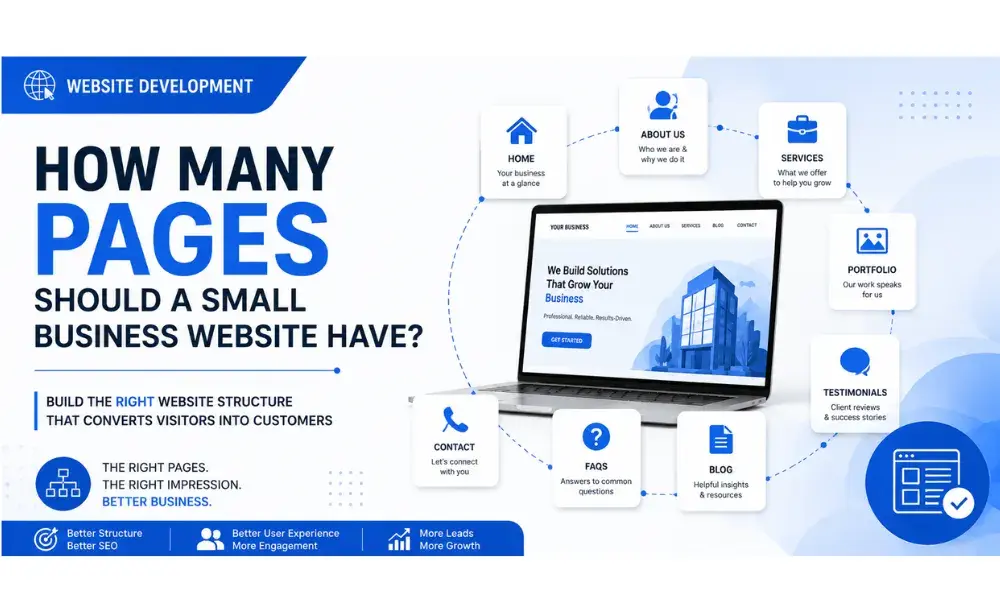
When a small business starts planning a website, one question often gets overlooked:
“How many pages do we actually need?”
Some businesses create a website with only three or four pages. Others end up with 20 or 30 pages without really knowing whether all of them are useful.
So, what is the right number?
The truth is that there is no fixed number of pages that every small business website needs. The ideal website structure depends on your industry, services, target audience, location, and business goals.
A local salon, a law firm, a construction company, and a digital marketing agency may all need completely different website structures.
Instead of trying to reach a particular number of pages, the better approach is to create enough useful pages to answer your customers' questions, explain your services, and support your business goals.
For many small businesses, a website with around 5 to 10 well-planned pages can provide a strong starting point.
A simple business website may include Home, About, Services, individual service pages, Contact, and sometimes a Blog or FAQ section.
However, the number can increase as the business grows.
For example, a company offering five different services may benefit from creating a dedicated page for each service rather than putting everything on one large services page.
The goal isn't to create more pages just for the sake of having more content.
Every page should have a purpose.
The homepage is usually the first page many visitors see.
It should quickly answer three basic questions:
Who are you?
What do you offer?
Why should someone choose you?
A strong homepage doesn't need to contain every detail about your business.
Instead, it should introduce your company, highlight your main services, establish trust, and guide visitors toward the next step.
For example, a web development company may introduce its services on the homepage and then direct visitors to dedicated pages for web development, eCommerce development, SEO, and custom software development.
This keeps the homepage easy to understand while allowing each service to have its own space.
For most small businesses, an About Us page is worth having.
Customers don't only want to know what you sell. They also want to know who they're dealing with.
Your About page can explain your company's background, experience, approach, and values.
For a local business, this page can also help build familiarity and trust.
But avoid turning your About page into a long company history that nobody wants to read.
Keep the information relevant to your customers.
Explain what makes your business different and why customers can feel confident working with you.
The Services page is one of the most important pages for a service-based business.
However, one common mistake is putting every service into a single page with only a short description.
Imagine a company offers:
Web Development, SEO,
Digital Marketing
eCommerce Development
Mobile App Development
Putting all of these into one page may make it difficult for visitors to understand what each service actually includes.
It can also limit the amount of useful information you can provide for each service.
This is where dedicated service pages become valuable.
If a service is important to your business and customers are actively searching for it, creating a dedicated page can be a good idea.
For example, instead of having one page called “Our Services,” you could have separate pages for:
Web Development
eCommerce Development
SEO Services
Digital Marketing
Each page can explain the service in detail, answer common questions, and include a relevant call to action.
From an SEO perspective, this structure can also give you the opportunity to target different search queries with more relevant content.
However, don't create separate pages for services that are almost identical just to increase the page count.
Quality and relevance are more important than quantity.
A local business may not need a huge website.
For example, a small restaurant could potentially have a Home page, About page, Menu page, Gallery, Location/Contact page, and perhaps a Reservations page.
A local plumber might need a homepage, About page, service pages, service-area information, and Contact page.
A dental clinic could have pages for different treatments, the team, location, FAQs, and appointments.
The ideal structure depends on what customers need to know before contacting the business.
For local businesses, it's especially useful to make important information easy to find, such as location, phone number, opening hours, services, and inquiry options.
A blog isn't mandatory for every business website.
But it can be useful if you want to attract visitors through Google and regularly publish helpful information.
For example, a web development company might publish articles about website development, SEO, website costs, e-commerce, and digital marketing.
A physiotherapy clinic might publish educational articles about common physical problems and treatment options.
A travel company could publish destination guides and travel tips.
The important thing is that the blog should answer questions your potential customers are actually searching for.
A blog shouldn't exist simply because someone said the following:
“Every website needs a blog.”
It should have a clear purpose.
An FAQ section can be useful when customers regularly ask similar questions.
Instead of answering the same questions repeatedly through phone calls or emails, you can provide clear answers directly on your website.
For example, a web development company could answer questions about the following:
Website development timelines
Website pricing
Technologies used
Maintenance
SEO
Hosting
Support
You don't necessarily need a separate FAQ page.
If there are only a few questions, placing FAQs on relevant service pages may actually provide a better user experience.
For almost every small business, yes.
A visitor shouldn't have to search through your website to figure out how to contact you.
Your contact page can include your phone number, email address, location, inquiry form, and other relevant contact information.
If you're a local business, adding a map and clear location information can also be useful.
You should also consider adding contact options in important places throughout the website instead of relying only on the Contact page.
For example:
Get a Quote
Book a Consultation
Call Now
Send an inquiry.
These calls to action can help visitors take the next step without having to navigate back to the Contact page.
This is a very important point.
Some businesses assume that creating 50 pages will automatically help them rank higher on Google.
It doesn't work that way.
Google doesn't reward a website simply because it has more URLs.
A website with 10 highly useful, well-optimized pages can potentially provide much more value than a website with 50 thin pages that contain almost the same information.
Every page should offer something useful.
If you're creating a page only because you want to add another keyword, you're probably taking the wrong approach.
Instead, ask:
“Does this page help my customer?”
If the answer is yes, the page may deserve to exist.
Imagine you visit a website and immediately see dozens of menu options.
Where do you click?
Too many pages can sometimes make a website confusing.
A good website structure should make it easy for visitors to understand where they are and where they should go next.
A simple structure might look like:
Home → Services → Individual Service → Contact
Or:
Home → Products → Product Category → Product → Enquiry
The exact structure depends on the business, but the principle is the same:
Make important information easy to find.
Your website structure can also influence how you organize your SEO strategy.
Instead of trying to rank one page for every keyword, you can create focused pages around different topics and search intents.
For example, a web development company might have:
Web Development Services
→ Business Website Development
→ eCommerce Development
→ Custom Web Development
→ WordPress Development
Each page can focus on its own topic while internally linking to related pages.
This creates a clearer structure for both users and search engines.
It also provides more opportunities to target relevant long-tail searches.
Keyword research is important, but it shouldn't control your entire website.
Let's say you find several variations of the same keyword.
Creating five separate pages with almost identical content isn't a good strategy.
Instead, consider whether those searches can be properly addressed by one strong page.
Your website should be created for people first and search engines second.
When visitors find useful information and have a good experience, your website is more likely to serve its business purpose.
For many small businesses, a structure like this can be a good starting point:
Home
The main introduction to your business and what you offer.
About Us
Your company story, experience, and approach.
Services
An overview of your main services.
Individual Service Pages
Dedicated pages for important services that deserve more detailed information.
Testimonials or Portfolio
Evidence that helps potential customers trust your business.
Blog or Resources
Useful content designed to answer customer questions and attract relevant search traffic.
Contact
Everything a visitor needs to get in touch with you.
This structure can then be expanded as your business grows.
You should consider adding pages when your business has something genuinely useful to say.
For example, you may add a new service page when you launch a new service.
You may create a case study when you've completed an important project.
You may create a location page when you start serving another city.
You may create a detailed FAQ when customers begin asking the same questions repeatedly.
This creates a website that grows naturally with the business instead of becoming unnecessarily large.
Location pages can be particularly useful for businesses serving multiple areas.
For example, a company may serve customers in the following areas:
Ambala, Chandigarh, Mohali, Panchkula, Delhi,
Gurugram
Instead of putting all locations into one paragraph, dedicated location pages may make sense if the business genuinely provides services in those areas and can provide useful, location-specific information.
However, simply creating dozens of city pages with identical content is not a good strategy.
Each location page should provide genuine value and relevant information.
Before deciding how many pages you need, ask yourself what you want your website to achieve.
If your goal is simply to establish an online presence, a small website may be enough.
If your goal is to generate leads, you'll probably need stronger service pages, landing pages, testimonials, and conversion-focused content.
If your goal is SEO traffic, you'll need a well-planned content structure.
If you're selling products, you'll need product and category pages.
In other words:
Your business goal should determine your website structure.
Not the other way around.
At Pansofic Solutions, website development starts with understanding what the business actually needs.
A small local business may only require a few carefully planned pages, while a growing company may need multiple service pages, landing pages, blogs, eCommerce functionality, or custom features.
The objective isn't to create the maximum number of pages.
It's to create a website where every important page has a clear purpose.
Pansofic works on different types of digital projects, including business websites, eCommerce websites, and custom digital solutions.
The website structure can be planned around your services, target audience, SEO goals, and future growth.
Final Thoughts
So, how many pages should a small business website have?
There is no magic number.
For many businesses, 5–10 well-planned pages can be a strong starting point. Others may need 15, 20, or more pages because their services, products, or target markets require more detailed information.
The important thing is not the number of pages.
It's the quality, purpose, and structure of those pages.
Every page should help your visitors understand your business, answer a question, build trust, generate an inquiry, or support your overall marketing strategy.
Instead of asking:
“How many pages should my website have?”
Ask:
“What information does my customer need before choosing my business?”
That question will usually lead you toward a much better website structure.
There is no fixed number, but many small business websites can start effectively with around 5–10 well-planned pages. The actual number depends on the business, services, products, and marketing goals.
It can be. A small business with straightforward services may only need Home, About, Services, Contact, and perhaps a Blog or FAQ section. Additional pages can be added as the business grows.
Not necessarily. Important services that have different customer needs or search intent can benefit from dedicated pages. Services that are very similar may be better combined into one useful page.
Not automatically. Search engines don't reward a website simply for having more pages. Useful, relevant, and well-optimized content is more important than having a large number of low-value pages.
A blog isn't essential for every business, but it can be valuable if you want to attract organic traffic and answer questions potential customers are searching for.
Not always. If you only have a few common questions, adding FAQs to relevant service pages may be more useful than creating a separate page.
They can be useful when a business genuinely serves multiple locations and can provide unique, helpful information for each area. Creating many duplicate location pages simply to target keywords is not recommended.
Yes. Your website should evolve with your business. New services, locations, products, case studies, and useful resources can all justify new pages when they provide genuine value.
Start by identifying your main services, target customers, and business goals. Then organize the information into logical pages that make it easy for visitors to understand your business and take action.
Yes. Pansofic can help businesses plan a website structure based on their services, target audience, SEO requirements, and long-term goals.


 Seo Admin
Jan 21, 2026
 Seo Admin
Nov 07, 2025
 Seo Admin
Apr 17, 2026
 Seo Admin
Dec 24, 2025
 Seo Admin
Jan 30, 2026